Bali, the Island of the Gods, is a magnet for digital nomads, traders, and crypto enthusiasts. From the bustling beaches of Kuta and Legian to the digital hub of Canggu and the upscale calm of Seminyak, the allure of managing your assets—like USD Tether (USDT)—while sipping a coconut is strong. But here’s the crucial question: Is USDT safe in Bali?
The answer is multifaceted. Physically, your USDT is safer than cash because it resides on the blockchain, secured by cryptography. Legally, Indonesia’s stance on crypto—a regulated commodity, but strictly not a means of payment—introduces a unique legal risk. Technologically, you face standard global cyber threats amplified by public Wi-Fi and high-traffic tourist areas like Bali Airport or Sanur. Understanding this delicate balance between global asset management and local Indonesian law is paramount to ensuring your USDT truly remains safe.
Three Pillars of USDT Safety in Bali
The safety of your USDT in Bali hinges on three distinct pillars. Neglecting any one of these can compromise your financial security and even expose you to legal consequences.
Pillar 1: Legal Compliance – The “Payment Prohibition” Rule
Indonesia’s central bank (Bank Indonesia) and regulatory bodies (BAPPEBTI/OJK) classify crypto assets like USDT as commodities for trading and investment, not as legal tender.
- The Risk: The single greatest legal risk in Kuta, Legian, and Seminyak is using USDT (or any crypto) to pay for local goods or services (e.g., hotel bills, scooter rentals, or café tabs). Indonesian Law No. 7 of 2011 on Currency strictly mandates the Rupiah (IDR) as the sole legal medium of trading. Violating this can lead to serious sanctions, including fines, up to one year in prison, or even deportation for foreigners.
- The Safety Precaution: Never advertise or agree to use USDT for payments. Keep your USDT strictly as an investment commodity stored in your private wallet. Only convert it to IDR using verified, compliant methods (Method 3 in our previous article) before spending.
Pillar 2: Digital Security – Protecting Your Private Keys
The blockchain doesn’t care if you’re relaxing on the beach in Canggu or waiting at the Bali Airport; digital threats are constant. Your USDT is only as safe as your private key.
- The Risk: Public Wi-Fi networks in cafes or hotels can be vulnerable to ‘man-in-the-middle’ attacks, allowing hackers to intercept sensitive data. Phishing attempts (fake exchange websites, malicious links) are common, especially targeting inexperienced crypto users. Physical theft (pickpocketing of a phone with an unsecured hot wallet) is a concern in crowded areas.
- The Safety Precaution:
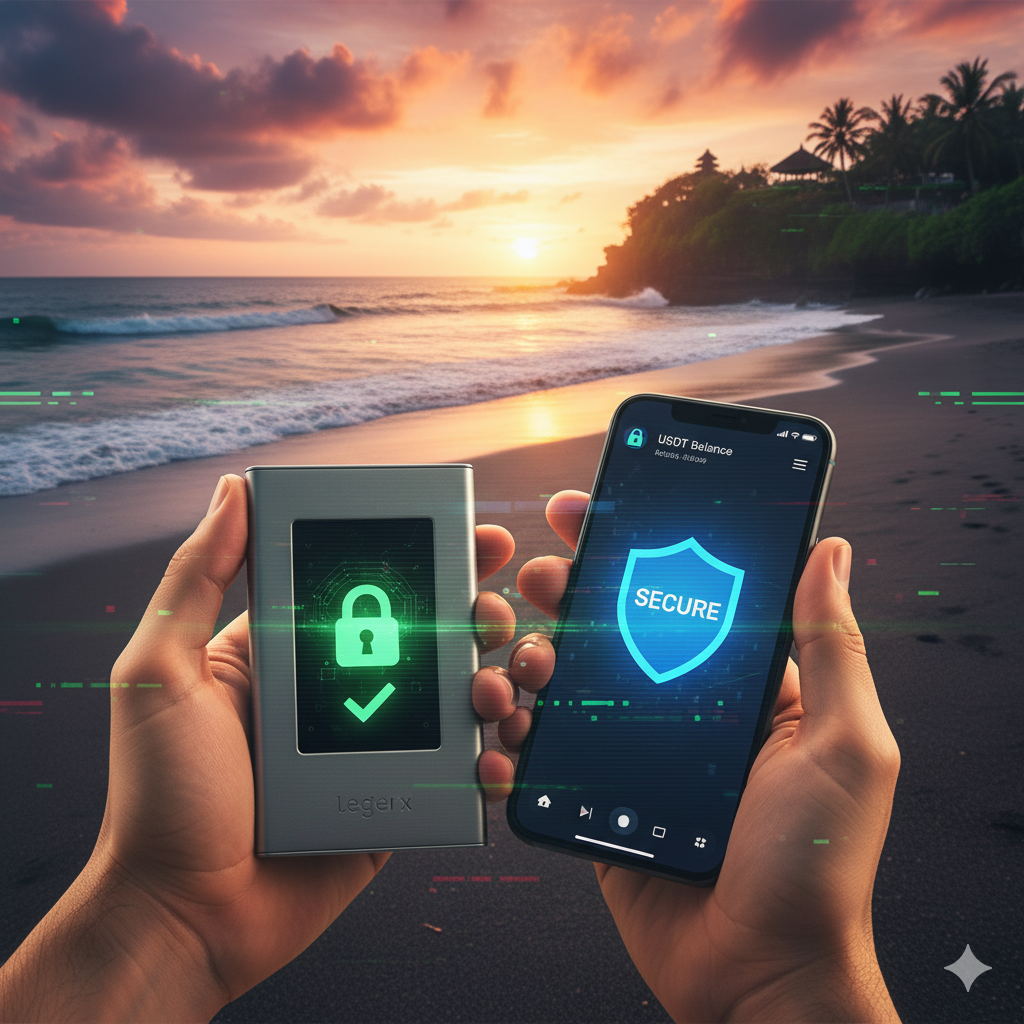
- Use Hardware Wallets: The ultimate protection. Keep the majority of your USDT holdings on a device that is never connected to the internet.
- VPN on Public Wi-Fi: Always use a Virtual Private Network (VPN) when conducting any financial activity or accessing your crypto platforms, particularly at the airport or busy spots in Seminyak and Sanur.
- Two-Factor Authentication (2FA): Enable robust 2FA on all trade and email accounts.
Pillar 3: Transactional Safety – Avoiding Scams and Fraud
Converting crypto to local fiat (or vice-versa) is a necessary step, but it is also the riskiest point in Bali. The popularity of P2P (Peer-to-Peer) trading in digital nomad communities makes it a hotbed for scams.
- The Risk:
- P2P Cash Scams: Arranging a face-to-face cash trading for large amounts in a quiet area exposes you to physical theft, common in areas like Kuta.
- Fake Transaction Proof: P2P scammers may upload fake bank transfer receipts, causing you to release USDT before the fiat money truly clears your account (Chargeback Fraud).
- The Safety Precaution:
- Verify Everything: If using a P2P platform (like Binance P2P), only deal with merchants with high ratings (98%+ completion) and many trades. Crucially, never release your USDT until the Rupiah is confirmed cleared in your bank account, not just ‘pending.’
- Use Regulated Channels: For maximum safety, utilize a verified Over-the-Counter (OTC) service that operates with strict KYC/AML protocols and provides a secure, private environment for the conversion.
Secure Your USDT Transactions with Verified Local Expertise
Managing digital assets in a foreign country, especially one with unique crypto regulations like Indonesia, adds a layer of complexity that can undermine your safety. You need to ensure both your digital keys and your physical transactions are protected and compliant.
If you are a traveler, trader, or digital nomad in Canggu, Kuta, Legian, or Seminyak needing to securely convert USDT to IDR, or vice versa, without compromising your legal or digital security, professional guidance is indispensable.
We offer a verified, secure, and compliant Over-The-Counter (OTC) service, specializing in assisting international individuals in navigating the Indonesian financial landscape. We eliminate the risks associated with public P2P cash exchanges and ensure full compliance with the no-crypto-as-payment law.
Our Safety Pledge:
- Private & Secure Conversion: We conduct transactions in a secure, discreet environment, far from the physical risks of crowded tourist areas.
- AML/KYC Compliance: We verify all exchanges, ensuring your transaction history is clean and legally sound, adhering to the highest standards.
- Expert Consultation: We provide clear guidance on best practices for securing your crypto wallet while enjoying Bali, from Sanur to Legian.
- Fast, Verified Settlements: Avoid P2P transaction delays and fraud. We provide instant, verified IDR bank transfers or USDT releases upon confirmation.
Don’t compromise security for convenience. Ensure your USDT remains truly safe from the moment you land at Bali Airport.
For verified, secure, and compliant USDT transactions in Bali, contact us directly: +6285167055236
Disclaimer: Our service is strictly for the legal exchange of crypto assets (commodities) for IDR. We maintain zero tolerance for the use of cryptocurrency as a means of payment for goods or services in Indonesia, in accordance with national law.