As you step off the plane at Bali Airport and begin your journey toward the bustling surf breaks of Kuta or the tranquil rice fields of Canggu. You observe the wild swings of the global cryptocurrency market. Bitcoin surges 10% in a week, Ethereum dips 5%, yet one asset remains stubbornly constant: Tether (USDT). For digital nomads, tourists, and local businesses in Legian and Sanur alike, USDT is the essential lifeline. A reliable, stable digital dollar.
Why, in a world defined by the volatility of digital assets, does 1 USDT consistently equal $1.00? The answer lies not in magic, but in a meticulously designed economic and financial mechanism known as the ‘peg’. Understanding this mechanism is vital. As it underpins your ability to seamlessly buy, sell, and trade without worrying about sudden losses. Making your finances as stable as the temples of Uluwatu. This guide, written by a digital finance Expert, provides the clarity and Authority you need on this digital anchor.
The Invisible Hand Protecting Your Digital Dollar in Bali
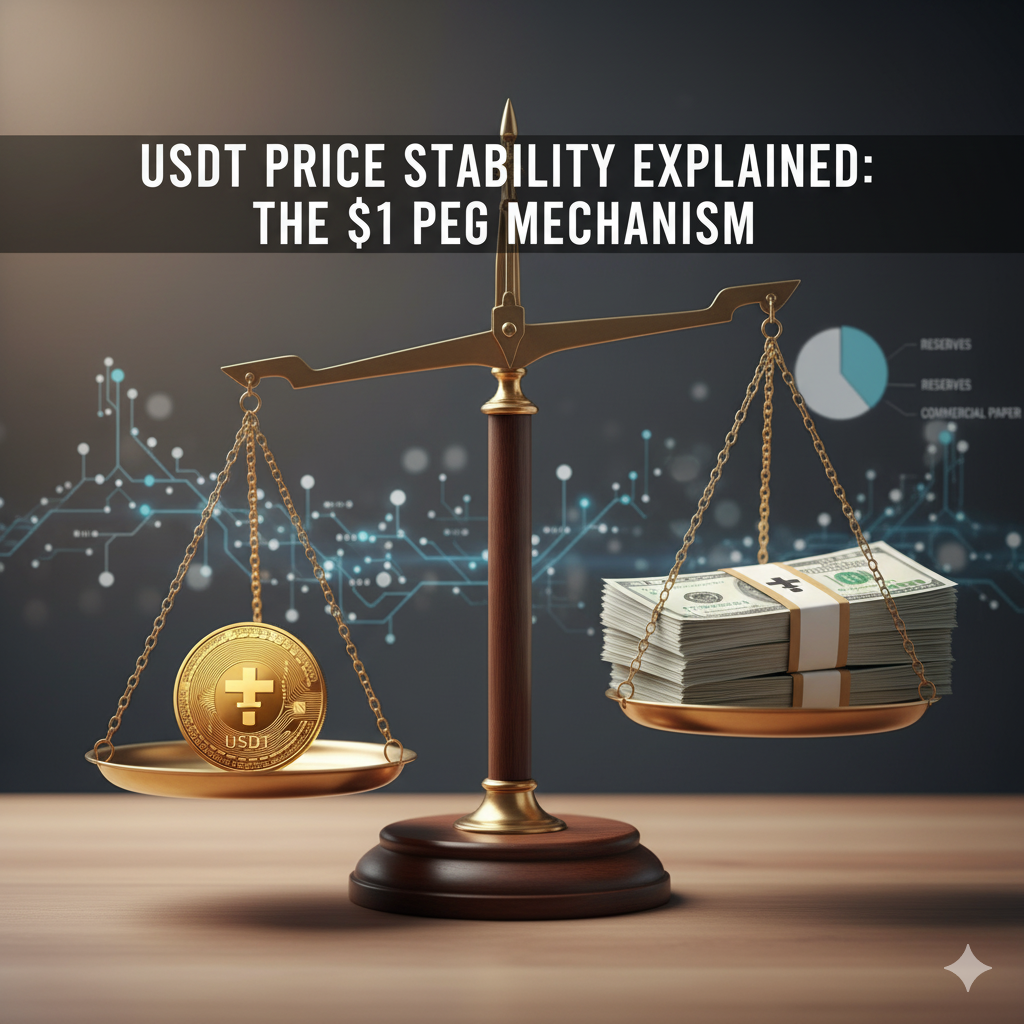
USDT’s stability is not accidental; it is maintained by two primary, interwoven forces: Reserve Backing and Market Arbitrage. These mechanisms work tirelessly, much like the coordinated waves that keep the surfing crowds happy in Seminyak.
The Foundation: Full Reserve Backing
The primary claim and foundational trust element of USDT is that every single token in circulation is backed by a corresponding equivalent value in the issuer’s reserves. These reserves are not just cash; they include a diverse portfolio designed to be liquid and secure, primarily:
- U.S. Treasury Bills (T-Bills): Short-term government debt, widely considered one of the safest investments globally.
- Cash and Cash Equivalents: Actual fiat currency and highly liquid assets.
- Other Investments: Including secured loans and precious metals like gold.
This reserve acts as a financial guarantee. If a user needs to sell 1,000 USDT, the issuer, in theory, has the reserve assets to redeem those tokens for $1,000 USD. This constant, open-ended offer of redemption is the ultimate stabilizing force.
- Crucial Takeaway: The peg is maintained because the issuer has the ability to redeem (burn) USDT tokens for the underlying asset ($USD), reducing supply and pushing the price back up if it ever dips.
- The Mechanism: Arbitrage in Action
While the reserve provides the authority for the peg, market players, known as arbitrageurs. Do the heavy lifting of price correction on a daily basis. Think of it as the ultimate digital quality control, operating 24/7 from Denpasar to Dubai.
Scenario 1: USDT Price Drops (The $0.99 Moment)
Imagine you are looking to buy USDT in Kuta and see the price momentarily drop to $0.99 on a global trade platform.
- Arbitrage Opportunity: A sophisticated trader will quickly buy millions of USDT at $0.99.
- Redemption: They can then redeem those tokens directly with the issuer for the full $1.00 USD (or the equivalent IDR via a local partner). Netting a profit of $0.01 per token.
- Price Correction: The massive buying pressure from arbitrageurs. Combined with the reduction in circulating supply from the token redemption (burning). Forces the market price of USDT immediately back toward $1.00.
Scenario 2: USDT Price Rises (The $1.01 Moment)
If demand skyrockets—perhaps due to a massive influx of tourists in Seminyak converting Rupiah into USDT—and the price briefly hits $1.01.
- Arbitrage Opportunity.Traders can sell their existing USDT at $1.01 and immediately request the minting of new USDT from the issuer by depositing $1.00 USD.
- Minting and Selling.They mint a new USDT for $1.00, sell it into the market at $1.01, pocketing the $0.01 profit.
- Price Correction. This process, called minting, injects new USDT supply into the market, and the massive selling pressure pushes the market price back down to $1.00.
This constant push-and-pull, driven by profit-seeking traders, ensures that any deviation from the $1.00 peg is instantly corrected. This is the expertise of the free market applied to a stable asset. Keeping your digital funds reliably convertible whether you are checking into a villa in Canggu or withdrawing funds at a local ATM in Sanur.
Guaranteeing Your Stable USDT-to-IDR Conversion in Bali
The stability of USDT is a global assurance, but converting it instantly and securely into Indonesian Rupiah (IDR) in Bali requires a reliable. Local partner who understands the local banking and regulatory landscape.
We provide the bridge between the global stability of USDT and the immediate, physical liquidity you need across Bali. Forget worrying about bank limits, slow transfers, or finding a trustworthy counterparty. We guarantee a smooth and compliant sell of your USDT for IDR cash or instant bank transfer, leveraging the stable peg mechanism.
- Stable Payout, Guaranteed. We honor the USDT peg by offering competitive and transparent IDR rates, ensuring you get the maximum value for your stable asset.
- Location Flexibility. Whether you’ve just arrived at Bali Airport and need cash immediately, or are managing investments from your digital nomad base in Canggu or Legian, we coordinate secure, timely transactions.
- Compliance-Oriented Service. We ensure every buy or sell transaction adheres to local AML/KYC guidelines, giving you Trust in a fully legitimate process.
Leverage the stability of USDT and combine it with the speed of our verified, local liquidity service. Your stable digital dollar deserves a stable, secure, and instant transition into Rupiah.
For immediate, secure, and expert support to legitimately BUY or SELL your stable Tether (USDT) for Indonesian Rupiah (IDR) anywhere in Bali, contact us now.
+6285167055236
Would you like to know more about the different types of stablecoins, such as algorithmic vs. fiat-backed, or how the Indonesian Rupiah peg works in local trade?