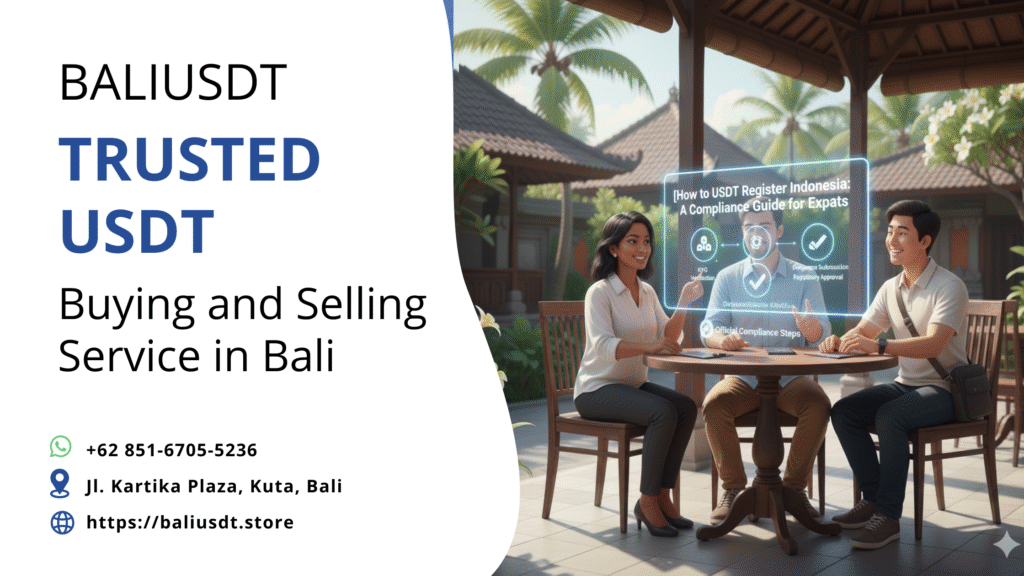
For international residents, digital nomads, and expats looking to use stablecoins like Tether (USDT) to manage their finances in Indonesia, the question of how to USDT register Indonesia is a natural one. Many foreign users are accustomed to centralized, government-mandated registration processes for financial instruments. However, you should understand that USDT, as a decentralized commodity traded on a blockchain, does not require personal registration by the individual user in the way a local bank account or business might. The term “USDT register” primarily applies to the crypto exchanges and platforms that facilitate its trade. Indonesian law, regulated by the Financial Services Authority (OJK), classifies crypto assets, including USDT, as a commodity that is legal to trade but not a legal tender or payment instrument. Consequently, this legal distinction forms the foundation for understanding how you use Tether while staying in Bali.
The Misconception of Individual USDT Registration
When an international resident asks how to USDT register Indonesia, they usually seek assurance that Indonesian law recognizes and protects their crypto activities. We must clarify that the registration burden primarily falls on the exchange platforms, not the end-user.
USDT as a Tradable Commodity
Indonesia’s regulatory framework for cryptocurrency is quite specific:
- Legal Status: The government officially recognizes cryptocurrency as a tradable commodity. You can legally buy, sell, and invest in it through licensed platforms.
- Prohibition as Payment: The Indonesian Rupiah (IDR) is the country’s only legal tender. Using USDT or any other crypto for direct payment for goods and services in shops, restaurants, or rental transactions is strictly prohibited. Violating this law can carry legal penalties.
Therefore, your compliance as an expat who holds USDT comes not from “registering” the asset personally. Compliance comes from ensuring that any official exchange or trading activity is done through platforms the Indonesian government has registered and licensed. Successfully navigating the market in Bali depends more on vendor compliance than on an individual user trying to figure out how to USDT register Indonesia.
Registration Requirements Target Exchanges, Not Users
The actual regulation surrounding crypto registration is directed at the Crypto Asset Physical Traders (PPMSE), the entities operating the exchanges. The law requires these platforms to register.
How Platforms Achieve Legal Status
For a platform to operate legally in Indonesia, it must adhere to strict government requirements, which include:
- OJK/Bappebti Licensing: The exchange must be approved and registered by the relevant financial supervisory bodies. This ensures the platform meets high standards for security, capital adequacy, and consumer protection.
- KYC/AML Compliance: All legal exchanges require users—both local and foreign—to complete a robust Know Your Customer (KYC) process. This KYC process is the closest an individual comes to “registering” their crypto activity. You must provide a valid passport and proof of identity.
- Local Tax Obligations: Registered exchanges must adhere to local tax regulations. They are responsible for collecting a Final Income Tax and potentially a Value Added Tax (VAT) on certain crypto transactions.
Therefore, instead of focusing on how to USDT register Indonesia personally, foreign users should ensure they are using platforms that have demonstrably completed their own legal registration process with the Indonesian government.
Using International Versus Local Exchanges in Indonesia
A significant financial decision for expats in Bali is choosing between their existing international crypto exchange and opening an account with a locally registered Indonesian exchange. Each option presents different benefits and logistical hurdles.
Navigating the KYC Process as a Foreigner
- International Exchanges (e.g., Binance): Most international exchanges allow registration using a foreign passport. Many travelers initially acquire their USDT this way before arriving in Bali. However, these platforms often struggle to integrate smoothly with local Indonesian bank accounts for fiat withdrawals (the off-ramp).
- Local Exchanges (e.g., Indodax): These platforms are fully regulated and integrated with Indonesian banks. A foreigner on a long-term visa (KITAS/KITAP) can usually register easily using their local identity documents, making it much simpler to convert USDT to IDR. However, tourists on short-stay visas might face more restrictions during the full KYC process on these local platforms.
Consequently, while international exchanges simplify your acquisition process—removing the need to determine how to USDT register Indonesia for buying the asset—they often complicate the essential step of converting USDT into usable Rupiah. Travelers must factor this crucial convenience into their financial planning for a long stay.
The Most Practical Solution: Secure Local Conversion in Bali
For the traveler or digital nomad, the most secure and convenient pathway is frequently a hybrid approach: acquire USDT on a low-fee international exchange and then use a trusted local partner in Bali for the final conversion to Rupiah. This strategy ensures both low transaction costs and high security.
The Value of a Trusted Local Off-Ramp
After acquiring your USDT, you must convert it into IDR to cover essential local expenses like rent, transportation, and groceries. This conversion (the “off-ramp”) is where a local, reputable partner provides the highest value.
- Security and Safety: You must handle the conversion of significant amounts of digital assets to physical cash or local bank transfers in a secure environment. A verified local office minimizes the risk of fraud and theft associated with unverified P2P transactions.
- Compliance and Guidance: A professional local service understands the commodity sale framework. They can guide you through the secure transaction, removing the complexity of local regulations. They clearly communicate that the transaction is a sale of a commodity, not a payment, helping you stay compliant. This practical guidance is often superior to trying to figure out how to USDT register Indonesia for this part of the process alone.
- Speed and Convenience: Immediate IDR payouts are essential for daily life on the island. Local partners offer same-day, often same-hour, service, which is a major advantage over waiting days for an international wire transfer to clear.
If you are already in Bali and need to sell your USDT for Rupiah both safely and legally, partnering with a trusted local exchange simplifies your financial life and ensures compliance. We strongly recommend securing your conversion needs by contacting [BaliUSDT.store] for professional assistance in legally converting your USDT commodity into Indonesian Rupiah.
Local Tips for USDT Use and Safety in Bali
Successfully using USDT in Bali involves respecting local laws and making personal safety a top priority. These practical tips help ensure your digital nomad lifestyle remains compliant and seamless.
- Rupiah Only for Payments: Always use IDR for daily purchases. Keep your USDT strictly for savings, investment, or international transfers. You must never attempt to use USDT as currency in local markets or with small businesses.
- Secure Your Wallet: Regardless of the “register” question, your highest priority remains wallet security. Use a hardware wallet for large sums and always enable Two-Factor Authentication (2FA) on any exchange you use.
- Verify Local Partners: Always verify the legitimacy of any local service you use for conversion. A reputable business will have a professional office and transparent, clearly stated procedures, giving you peace of mind.
By following these guidelines, you move beyond the initial question of how to USDT register Indonesia and focus on leveraging USDT as a stable and secure asset management tool throughout your time in this beautiful destination.
Conclusion
The path to using USDT in Indonesia does not require individual users to figure out how to USDT register Indonesia. Instead, travelers must focus on ensuring that any crypto activity is conducted through exchanges and service providers who comply with Indonesian law. For the international traveler or expat in Bali, the most efficient and safest strategy is a dual approach: acquire your USDT cheaply on an international exchange and then utilize a reputable, local conversion service for the critical off-ramp to Indonesian Rupiah. This strategy provides the best balance of low acquisition cost, high security, and seamless integration into the local economy, keeping your financial life simple and compliant.
📲 WhatsApp us to sell your USDT safely: +62 851-6705-5236
Check today’s USDT selling rate via Whatsapp
Pemogan, Denpasar.
JL. KARTIKA PLAZA, KUTA, KEC. KUTA, KAB. BADUNG, BALI 80361
USDT is processed as a commodity sale in Indonesia, not as a direct payment method.
Read also: USDT Price Fluctuations Explained: What Travelers Need to Know