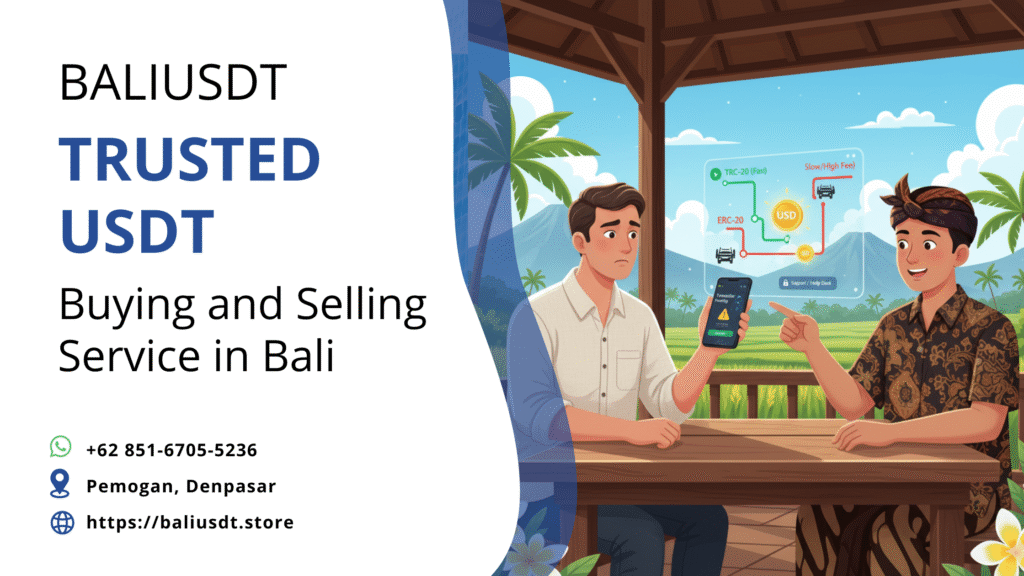
As an international traveler, expat, or digital nomad relying on stablecoins like Tether (USDT) for financial agility in Bali, encountering a stuck or unconfirmed transfer can be profoundly stressful. When your USDT transaction is pending—meaning it has been broadcast to the blockchain network but not yet included in a confirmed block—you might immediately wonder how to contact USDT for unconfirmed transfer assistance. It is essential to understand that USDT (Tether) is the issuer of the commodity, not the network operator. Therefore, contacting Tether is only the final resort, and the immediate solution lies in diagnosing the issue on the underlying blockchain.
Diagnosing the Unconfirmed USDT Transfer
Before attempting to contact any third party, the first and most critical step is to correctly diagnose why your USDT transfer is unconfirmed. The root cause almost always relates to the specific blockchain network (e.g., Tron TRC-20 or Ethereum ERC-20) you used, not the Tether company itself.
1. Identify the Transaction Status
The key to resolving the issue is finding the Transaction ID (TXID or Hash) and using a corresponding blockchain explorer.
- Locate the TXID: Find the transaction details within your sending wallet or exchange. The TXID is the unique identifier for your transfer.
- Use an Explorer: Go to the correct explorer for the network you used (e.g., TronScan for TRC-20, Etherscan for ERC-20) and input the TXID.
- Check the Status: The explorer will show the status. If it reads “Pending,” “Unconfirmed,” or “0 Confirmations,” it means the transaction is stuck in the network’s “mempool”—a waiting area for transactions.
2. Common Causes of Pending Status
Understanding the cause dictates the action required. Most unconfirmed USDT transfers are due to one of these common issues:
- Low Transaction Fee (Gas): Miners and validators prioritize transactions with higher fees. If you set the fee too low, especially on a congested network like Ethereum, your transaction will be perpetually bypassed.
- Network Congestion: During periods of high trading volume or market volatility, the network mempool becomes flooded. Even standard fees may not be enough to get prioritized, leading to significant delays. This is particularly noticeable on the Ethereum network.
- Wallet or Exchange Delay: Sometimes, the sending wallet or exchange may hold the transaction internally for security checks before even broadcasting it to the network, resulting in an apparent “pending” status on their interface.
Resolving the Issue: Actionable Steps for Nomads
For most unconfirmed transfers, the solution involves taking action on the blockchain network, not immediately asking how to contact USDT for unconfirmed transfer.
Step 1: Be Patient (Especially on TRC-20)
If you are using the high-speed, low-fee Tron (TRC-20) network, an unconfirmed status is rare unless there’s massive, global congestion. Wait for a short period, perhaps 30 minutes to a couple of hours. Often, the transaction simply clears once a small network backlog subsides.
Step 2: Utilize Fee Acceleration (ERC-20 Only)
If you used the slower Ethereum (ERC-20) network, a low fee is the likely culprit. You may have options to “speed up” the transaction:
- Replace-by-Fee (RBF): Some wallets allow you to resend the transaction with the same details but a higher gas fee. This effectively tells miners to replace the old, low-fee transaction with the new, higher-fee one.
- Cancel and Resend: You can attempt to “cancel” the stuck transaction by sending a zero-value transaction to your own address with the same nonce (transaction number) but a much higher gas fee. This can replace the original, unconfirmed transfer. Note: This is an advanced technique and should only be attempted if you understand the underlying blockchain mechanics.
Step 3: Contact the Sending Exchange/Wallet Support
If you sent the USDT from a centralized exchange (like Binance, KuCoin, or Huobi) or a managed wallet, their support team should be your first point of contact.
- Provide Details: Give them the TXID, the amount, the receiving address, and the time the transaction was initiated.
- Internal Review: They can often confirm if the delay is internal (e.g., a security hold) or external (stuck in the mempool). They may also have tools to resubmit the transaction with a higher fee if necessary.
How to Contact USDT (Tether) for Specific Recovery Issues
Understanding how to contact USDT for unconfirmed transfer becomes relevant only in specific, usually catastrophic, error scenarios where funds are potentially lost, not just delayed. Tether is not designed to assist with routine network congestion issues. Their support is primarily for platform-level issues or token recovery.
Tether Token Recovery
Tether’s support channels are primarily dedicated to Token Recoveries, which applies when USDT has been mistakenly sent to an unsupported address, usually across the wrong blockchain network.
- When to Contact Tether: Contact them only if you mistakenly sent your TRC-20 USDT to an ERC-20 address, or vice-versa, resulting in tokens being essentially stuck in an unrecoverable location.
- Prerequisites: Tether typically requires large amounts (e.g., recovery requests for amounts exceeding $1000) and charges a fee (up to 10% or $1000, whichever is greater) for their discretionary recovery service. Furthermore, you must be a fully verified user under Tether’s Terms of Service.
- The Process: You must contact them through their official support portal (usually via a knowledge base or dedicated ticket system) under the ‘Token Recoveries’ category. They will require all transaction details and verification documents. Crucially, this process can take several months.
Important Note: If your transfer is merely unconfirmed due to a low fee or network congestion, Tether cannot and will not assist. Your problem is with the decentralized blockchain network, not the centralized token issuer.
🇮🇩 Keeping Your Finances Safe and Moving in Bali
A stuck USDT transfer is more than just an inconvenience for a traveler; it can disrupt paying for accommodation or securing local currency. Security and preparedness are key to avoiding these scenarios altogether.
Prioritize Low-Fee, Fast Networks
Always use the Tron (TRC-20) network for day-to-day transfers and converting USDT to Indonesian Rupiah (IDR). Its near-instant speed and fixed, minimal fee structure dramatically reduce the chances of encountering an unconfirmed transaction due to congestion or low fees.
Use Trusted Local Exchange Services
When converting your stablecoin into IDR, use a reputable local Over-The-Counter (OTC) service. If a local partner, like our team at Pemogan, Denpasar, experiences a temporary network delay, they have the local expertise and infrastructure to monitor the unconfirmed transfer and advise on the best course of action. This collaboration is much more effective than trying to ask how to contact USDT for unconfirmed transfer alone.
We ensure all our transactions are processed on the most efficient networks, minimizing the risk of delays. To learn about our secure and swift IDR exchange process, visit BaliUSDT.store.
Document Everything
For any transfer—confirmed or unconfirmed—you must save the following information:
- TXID: The unique blockchain identifier.
- Sending Address and Receiving Address.
- Amount and Timestamp.
- Network Used (TRC-20, ERC-20, etc.).
This documentation is essential if you ever need to contact your exchange, wallet provider, or, in the worst-case scenario, pursue an answer for how to contact USDT for unconfirmed transfer.
Conclusion: Prevention is Better Than Contact
For travelers and digital nomads, a proactive approach to stablecoin management is the best defense against unconfirmed transactions. The key takeaway is this: most pending USDT transfers are solvable by checking the blockchain explorer and, if necessary, using fee acceleration tools available on your sending wallet or exchange. Only in cases of significant, unrecoverable network mistakes (like sending to the wrong token address) is asking how to contact USDT for unconfirmed transfer a relevant step. By sticking to the fast and reliable TRC-20 network, double-checking all addresses, and partnering with verified local exchange services, you minimize risk and maximize your time enjoying Bali.
Visit our office in Bali for secure USDT selling
📲 WhatsApp us to sell your USDT safely: +62 851-6705-5236
USDT is processed as a commodity sale in Indonesia, not as a direct payment method.
Read also : How to Change Ethereum to USDT KuCoin: Traveler’s Guide to Stablecoin