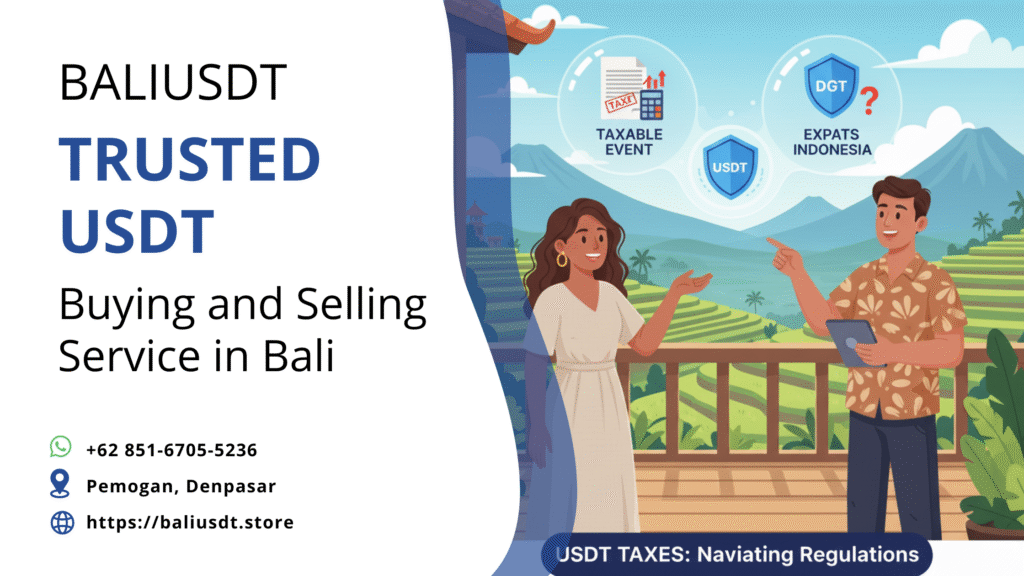
For the international traveler, digital nomad, or long-term expat managing decentralized finances, the question is USDT taxable demands a comprehensive answer. While Tether (USDT) is a stablecoin designed to maintain a $1.00 USD peg, nearly every major jurisdiction globally—including Indonesia—treats it as a form of taxable property or a digital financial asset, not as currency. This means engaging in transactions involving USDT, such as swapping it for another cryptocurrency, earning yield on it, or—most critically for a traveler—selling it for fiat currency (like Indonesian Rupiah), constitutes a taxable event. Travelers must understand the specific tax regime in Indonesia for secure and compliant financial operations during their stay in Bali.
The Global Principle: Stablecoins are Taxable Assets
Globally, the answer to is USDT taxable depends not on its stability but on its legal classification. Tax authorities worldwide view stablecoins as assets or property.
Capital Gains on Stablecoins
Even without price volatility, stablecoins can technically trigger capital gains or losses upon disposal.
- Taxable Disposal Events: A disposal event occurs every time you sell USDT for fiat currency, swap USDT for Bitcoin, or spend USDT to purchase goods or services. (Note that direct spending is illegal in Indonesia).
- The Near-Zero Gain Exception: Because USDT is pegged to the US Dollar, the gain or loss realized when you dispose of it is usually negligible—close to zero. However, tax law dictates you still recognize and report the transaction. The asset’s value may fluctuate slightly between the time you acquire and dispose of it.
- Income Tax on Earnings: Furthermore, if you earn USDT as income—for instance, through staking rewards, a salary, or referral bonuses—that amount constitutes ordinary income. It is taxable at the fair market value of the USDT when you receive it. This confirms that the question, is USDT taxable, requires an understanding of the transaction type.
Consequently, while the capital gain from merely holding USDT is minimal, the act of transacting with it carries tax implications you must manage.
Indonesia’s Specific Tax Regime for Crypto Assets
Indonesia has a clear and formalized tax structure for digital assets. Expats must focus on two key areas: the asset’s classification and the final tax rate applied to its sale.
The Final Income Tax on Selling USDT
Indonesia’s regulations treat the sale of crypto assets, including stablecoins, under a final income tax regime.
- Digital Financial Asset Status: The Indonesian government has classified crypto assets as “digital financial assets” (akin to securities). This removes their previous status as VAT-able goods. Thus, the direct transfer of the asset is exempt from Value Added Tax (VAT).
- The Final Tax Rate: Sellers of crypto assets are subject to a Final Income Tax (under Article 22), calculated on the total transaction value. This tax is “final.” This means you owe no further tax on that specific transaction once the initial tax is withheld.
- Domestic vs. Foreign Platform Rates: The specific rate for this final income tax depends on the platform you use:
- Domestic Registered Platforms: The rate is currently set at 0.21% of the transaction value.
- Foreign Platforms: The rate can be higher, often set at 1% of the transaction value. In some cases, the seller must self-remit this tax if the foreign platform is not appointed as a tax collector.
Therefore, for the traveler accessing Rupiah, selling USDT locally ensures the transaction is compliant and that the necessary final tax is withheld efficiently.
Practical Tax Compliance for the Traveler in Bali
For foreign travelers and digital nomads, compliance hinges on understanding when the taxable event occurs. They must also ensure the proper party collects the tax.
The Conversion Point: From USDT to IDR
The moment you sell your USDT for Indonesian Rupiah (IDR) is the critical taxable event for travelers. This is the moment to ask, is USDT taxable, and to ensure you have the correct documentation.
- Withholding Responsibility: Generally, the electronic trading system operator (PPMSE) that facilitates the sale—whether a local exchange or a verified conversion service—holds the legal responsibility to withhold this Final Income Tax at the moment of the transaction. They then remit this tax to the Directorate General of Taxes (DGT).
- Tax Treaties and Exemption: Foreign taxpayers from jurisdictions with a tax treaty with Indonesia may be eligible for exemption from this tax. They must submit a Certificate of Domicile to the withholding agent (PPMSE). Travelers must clarify their residency status and available tax relief options.
- Focus on Local Compliance: To simplify compliance and avoid the higher 1% tax rate, travelers should prioritize using established, legally operating services in Indonesia for their USDT off-ramps. We offer guidance for selling USDT legally in Indonesia, ensuring this tax is handled correctly.
Ultimately, while the tax itself is a low percentage, the security of compliant asset disposal proves essential.
Safety and Avoiding Payment Misuse
Beyond the tax itself, travelers must remain focused on the strict Indonesian prohibition against using any cryptocurrency, including USDT, as a form of payment.
The Legal Distinction in Indonesia
Indonesia’s currency law designates the Rupiah (IDR) as the only legal tender. This impacts the answer to is USDT taxable.
- Not a Payment Method: You cannot use USDT to pay for rent, scooter rentals, or meals in Bali. Local businesses risk penalties for accepting crypto payments.
- The Commodity Sale Requirement: The only legal method to convert your USDT to usable funds is through a commodity sale to obtain IDR. This legal classification is what triggers the Final Income Tax.
- Secure Off-Ramp Necessity: To secure your funds and ensure both tax and currency compliance, you must conduct this sale via a trusted, transparent service. This avoids the high risks of informal cash transactions or black-market exchanges, which often overlook the required tax withholding.
We strongly encourage travelers to check today’s USDT selling rate via WhatsApp and to visit our office in Pemogan, Denpasar, for secure, compliant transactions.
Conclusion
Is USDT taxable? Yes, any transaction involving the sale, swap, or earning of stablecoins, including USDT, is recognized as a taxable event globally. For travelers in Indonesia, the critical moment is when you sell your USDT for Indonesian Rupiah. Indonesian law subjects this transaction to a Final Income Tax. Compliant, local service providers efficiently withhold this tax at a low percentage rate (typically 0.21%). By ensuring a regulated entity handles your USDT sale, you achieve safety, regulatory compliance, and a simplified tax process, allowing you to focus on enjoying your time in Bali.
Get guidance for selling USDT legally in Indonesia
📲 Whatsapp us to sell your USDT safely: +62 851-6705-5236
Visit our office in Bali for secure USDT selling: Pemogan, Denpasar
USDT is processed as a commodity sale in Indonesia, not as a direct payment method.
Read also: Withdraw USDT from Binance to Bank Account: A Traveler’s Guide