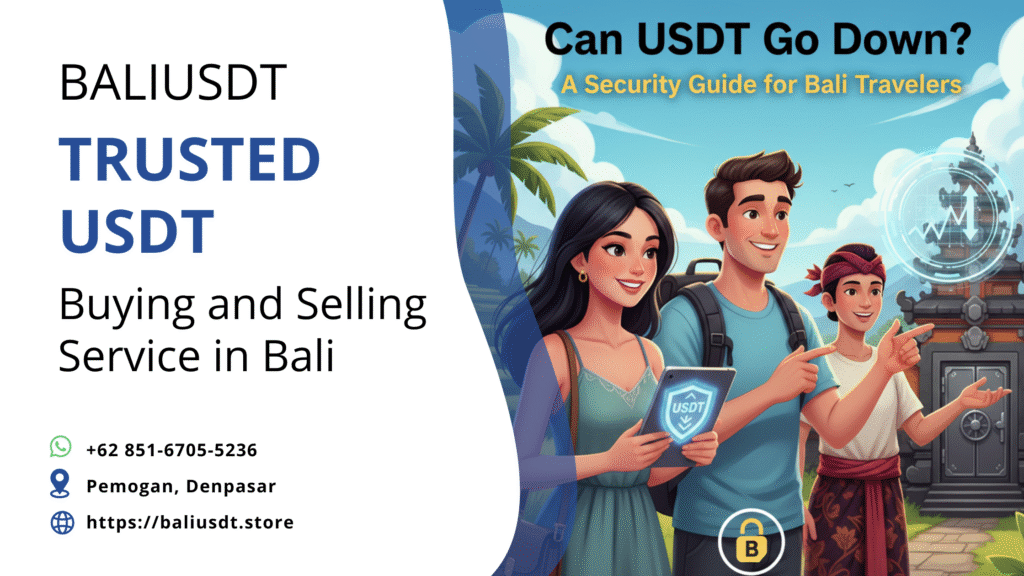
Can usdt go down while you are navigating the lush rice terraces of Ubud or preparing for a luxury beach club sunset in Canggu? This is a question of paramount importance for the modern international traveler in Indonesia. As digital assets become a staple for travel budgeting, understanding the stability of your funds is just as critical as knowing the local customs. While Tether (USDT) is designed to stay pegged to the US Dollar, market dynamics can occasionally cause fluctuations. For a tourist relying on these funds for transportation, accommodation, and dining, even a minor dip can cause unnecessary stress. This comprehensive guide explores the mechanics of stablecoin stability, the local legal landscape in Indonesia, and how to safely convert your digital assets into Indonesian Rupiah (IDR).
The Mechanics of Stability: How Tether Maintains Its Value
When travelers ask, “can usdt go down,” they are usually inquiring about a phenomenon known as “depegging.” Unlike volatile assets like Bitcoin, USDT is a fiat-backed stablecoin. This means that for every token in circulation, the issuer, Tether Limited, aims to hold an equivalent value in reserves, such as US Treasury bills and cash deposits. Under normal conditions, these reserves act as a safety net, allowing the price to remain at a steady $1.00.
However, historical data shows that brief periods of volatility can occur. During extreme market panics or liquidity shortages on specific exchanges, the price can fluctuate by a few cents. While these events are usually temporary, they serve as a reminder that no digital asset is entirely immune to market forces. For a visitor in Bali, these small movements are usually negligible, but staying informed helps you time your conversions for maximum value.
Legal Classification: USDT as a Commodity in Indonesia
Understanding the legal framework is essential for any foreign visitor. You might wonder, “can usdt go down in value legally within the country?” In Indonesia, the regulatory authority has shifted as of 2025 to the Financial Services Authority (OJK). Under current laws, cryptocurrency—including USDT—is strictly classified as a digital financial asset or a commodity. It is not recognized as legal tender.
This distinction is the most important tip for tourists: you cannot pay for your villa, your surf lessons, or your “Bintang” beer directly with USDT. According to the Currency Law, all domestic transactions must be settled in Indonesian Rupiah (IDR). Therefore, while you can legally hold and trade USDT as an investment or travel fund, you must convert it to cash through a compliant provider to spend it. This keeps you on the right side of the law and avoids potential issues with local merchants.
Managing Risks: Security Tips for Digital Nomads
Even if the answer to “can usdt go down” is “rarely,” you should still practice high-level security to protect your travel budget. Bali is a haven for digital nomads, but using public Wi-Fi at a busy cafe in Seminyak to manage your wallet can be risky. Hackers often target unencrypted networks to intercept private keys or login credentials. Always use a secure 5G connection or a reputable VPN when performing transfers.
Another key risk is “centralization.” Because Tether is managed by a single company, they have the ability to freeze addresses linked to illegal activity or hacks. For a legitimate traveler, this is rarely an issue, but it highlights why it is better to move only what you need to an exchange and keep the rest in a secure, self-custody wallet. By spreading your funds across different storage methods, you ensure that a single technical glitch or market dip won’t leave you stranded without local currency.
Cashing Out Safely in Pemogan, Denpasar
If you are currently in Bali and asking, “can usdt go down before I get my cash?”, the best strategy is to use a reliable over-the-counter (OTC) service. While online P2P platforms exist, they often carry risks of “triangular scams” or bank account freezes. For international tourists, a physical office provides a layer of accountability and safety that an anonymous app cannot match.
Located in Pemogan, Denpasar, BaliUSDT.store offers a professional environment for converting your digital commodities into physical Rupiah. Visiting a physical office in Pemogan, Denpasar allows you to complete your transaction in a secure setting, with transparent rates and immediate payouts. This is especially helpful for large transactions, such as paying for a month-long villa rental or a specialized diving excursion in Nusa Penida.
- Safety: Face-to-face transactions in a secure office prevent common online scams.
- Convenience: Our central location in Pemogan, Denpasar is easily accessible from major hubs like Kuta and Sanur.
- Reliability: We provide competitive market rates, ensuring you get the most IDR for your USDT.
Cultural Notes and Local Tips for Using Cash
Once you have converted your USDT into Indonesian Rupiah, navigating the local culture becomes your next priority. While high-end beach clubs and malls in Denpasar accept credit cards, the true heart of Bali—the local “warungs,” traditional markets, and temple entrance gates—operates almost exclusively on cash. Having small bills (10,000 to 50,000 IDR) is incredibly helpful for “parkir” (parking) fees and small donations.
When paying, it is customary and respectful to use your right hand. In Balinese culture, the left hand is traditionally considered “unclean,” so using your right hand to hand over money shows respect for local traditions. Furthermore, always be wary of roadside money changers offering “too good to be true” rates. These often involve sleight-of-hand tricks. By cashing out your USDT at a reputable office first, you avoid these common tourist traps and enter the local economy with confidence.
Conclusion: Securing Your Financial Future in Bali
In conclusion, while the question “can usdt go down” is a valid concern for any cautious traveler, the stability of Tether remains high compared to other digital assets. By understanding that USDT is a commodity and not a currency, and by following the OJK regulations, you can enjoy a seamless financial experience. Your digital wallet provides the flexibility to carry your wealth across borders, but it is the local Indonesian Rupiah that will actually fuel your adventures.
Protect your funds by using secure networks, avoiding roadside scams, and visiting our professional office in Pemogan, Denpasar for your cash needs. Bali is an island of magic and tradition; let your financial planning be the foundation that allows you to explore it without worry. Whether you are here for a short holiday or a long-term remote work stint, mastering the bridge between digital assets and local cash is the key to a successful journey.
Ready to Sell Your USDT Safely in Bali?
Don’t let market fluctuations or exchange confusion interrupt your holiday. If you need a secure, legal, and professional way to turn your USDT into Indonesian Rupiah, our team in Pemogan, Denpasar is ready to help you today.
- Visit our office in Bali for secure USDT selling (Located in Pemogan, Denpasar)
- Check today’s USDT selling rate via WhatsApp
- Get guidance for selling USDT legally in Indonesia
📲 WhatsApp us to sell your USDT safely: +62 851-6705-5236
USDT is processed as a commodity sale in Indonesia, not as a direct payment method.
Read also: Can I Send USDT ERC20 to USDT TRC20? A Critical Guide