Why is USDT BTC price different from USDC is a common question among the tech-savvy expatriates and digital nomads who call the surf-side cafes of Canggu or the coworking hubs of Ubud home. As you navigate the local financial landscape in Bali, you might notice that the Bitcoin (BTC) exchange rate isn’t identical across all stablecoin pairs. Whether you are checking your portfolio while waiting for a sunset at Echo Beach or planning to sell some assets for your monthly villa rent, these minor price gaps can be confusing. In this guide, we will explore the market mechanics, liquidity factors, and regional nuances that cause these discrepancies and how you can manage them efficiently in Indonesia.
Understanding Market Liquidity and Trading Pairs
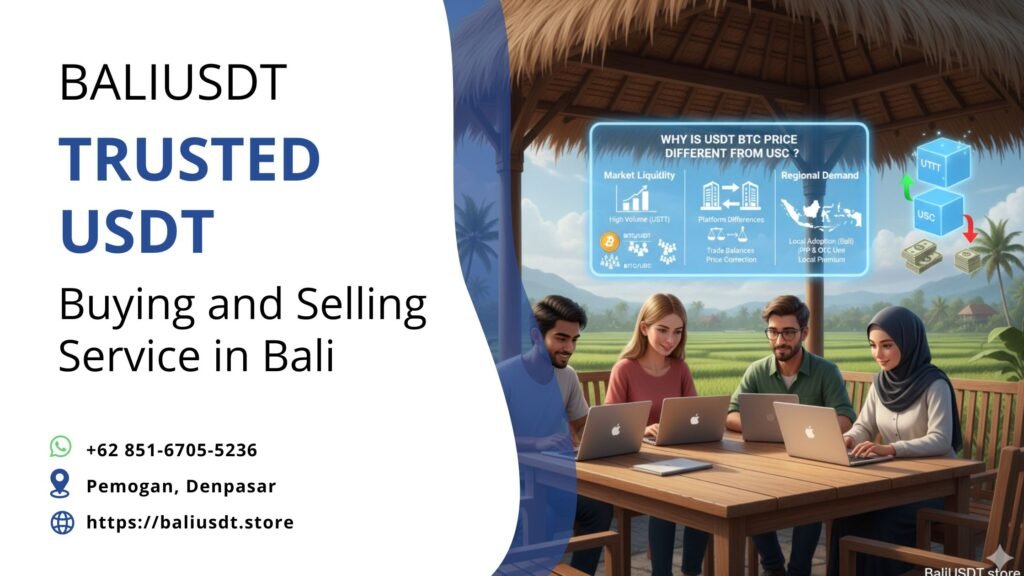
The primary reason why is USDT BTC price different from USDC lies in the concept of market liquidity. Each trading pair—such as BTC/USDT and BTC/USDC—operates as its own separate “market” with its own set of buyers and sellers. Tether (USDT) is currently the most widely used stablecoin globally, commanding significantly higher trading volumes than USD Coin (USDC). Because there are more participants trading BTC for USDT, the market is “deeper,” meaning large trades are less likely to move the price significantly.
On the other hand, USDC, while highly regulated and transparent, often has lower trading volume on international exchanges. This difference in activity means that the bid-ask spreads (the gap between the highest buy price and the lowest sell price) can vary. When demand for Bitcoin surges in the USDT market specifically, the price might tick up faster than it does in the USDC market, creating a temporary price gap. For a traveler in Bali, choosing the more liquid USDT pair usually results in “tighter” pricing and less slippage.
The Role of Exchange Architecture and Arbitrage
Another factor explaining why is USDT BTC price different from USDC is the way different exchanges manage their order books. Some exchanges are primarily “USDT-native,” meaning they use Tether as their base currency for almost every asset. Others, particularly those based in the United States or Europe, may prioritize USDC for regulatory reasons. These institutional preferences create isolated pools of liquidity where prices can diverge based on the local demand of that specific platform’s user base.
Professional traders use a strategy called “arbitrage” to keep these prices in check. When they notice a significant gap—for instance, if BTC is cheaper in USDC terms than in USDT—they will buy the cheaper asset and sell the more expensive one. However, arbitrage isn’t instantaneous; it takes time to move funds between networks and execute trades. During periods of high volatility, such as a sudden market rally, these gaps can widen significantly before arbitrageurs can close them. For the average Bali nomad, this means the price you see at 10:00 AM might differ slightly depending on which stablecoin you are holding.
Regional Demand and Local Bali Dynamics
Bali attracts an incredibly international audience, from European remote workers to Asian crypto investors. This diversity contributes to why is USDT BTC price different from USDC on a local level. In Southeast Asia, USDT remains the dominant stablecoin for peer-to-peer (P2P) transactions and over-the-counter (OTC) sales. This localized demand can drive the value of USDT slightly higher compared to USDC within the region.
If you are planning to sell your digital assets for Indonesian Rupiah (IDR) to fund a scuba diving trip in Amed or a trek up Mount Batur, you will find that the local infrastructure is more heavily geared toward USDT. Most local traders and exchange desks have deeper liquidity in USDT pairs. Consequently, if you are holding USDC, you might find that the “effective” price for your Bitcoin is slightly lower after accounting for the extra steps needed to convert it into a locally liquid asset. To ensure you are getting the most accurate local rates, you can BaliUSDT.store to check current market conditions.
Blockchain Network Fees and Transfer Speeds
The technical side of these stablecoins also plays a role in why is USDT BTC price different from USDC. USDT is widely used on the Tron (TRC-20) network, which is known for its speed and low fees, making it a favorite for travelers. USDC is prominently used on Ethereum (ERC-20) and Solana. If the Ethereum network becomes congested, the cost of moving USDC increases, which can indirectly impact the trading price as market participants factor in the higher “cost of carry.”
For an expat managing their daily budget, these network fees are just as important as the exchange rate. If the BTC/USDT price is $10 higher than the BTC/USDC price, but the fee to transfer USDT is $15 lower than the fee for USDC, the USDT pair remains the better choice. In Bali, where convenience and speed are key to maintaining a stress-free nomadic lifestyle, the TRC-20 version of USDT is often the most practical tool for moving wealth into the local economy safely and legally.
Safety and Compliance for Foreign Travelers
While understanding why is USDT BTC price different from USDC is technically helpful, your primary concern as a tourist should always be safety and legal compliance. In Indonesia, cryptocurrency is strictly regulated by BAPPEBTI and the OJK. While it is legal to own and trade crypto as a commodity, you cannot use it as a direct payment method for goods or services. Whether you are buying a handmade batik or paying for a surf lesson, you must first convert your assets into IDR.
To stay safe while managing your funds:
- Avoid Unverified P2P: Never meet strangers from social media groups for cash exchanges; always use a professional office.
- Verify the Network: Ensure you are using the correct network (like TRC-20) when sending funds to avoid permanent loss.
- Keep Private Keys Private: Never share your recovery phrases or passwords in public coworking spaces or over open Wi-Fi.
- Use Trusted Desks: Stick to established services in areas like Pemogan or Denpasar that understand the needs of the international community.
By staying aware of the market factors and local regulations, you can navigate the subtle differences between USDT and USDC with the confidence of a professional. This allows you to focus on what matters most: enjoying the incredible culture, food, and landscapes that Bali has to offer.
Conclusion
Navigating the world of digital finance as a traveler requires a mix of technical knowledge and local savvy. The answer to why is USDT BTC price different from USDC boils down to a combination of market liquidity, exchange-specific demand, and the speed of arbitrage. While these price gaps are usually small, they represent the complex, 24/7 nature of the global crypto market. For the Bali expat, USDT remains the most practical choice due to its deep local liquidity and the widespread adoption of low-fee networks like Tron.
As you plan your next month in the tropics, keep an eye on these market dynamics, but always prioritize security and professional service. Dealing with your digital assets correctly ensures your nomadic journey remains smooth, profitable, and safe.
Visit our office in Bali for secure USDT selling and let our professional team help you get a fast quote for your assets. We are located in Pemogan, Denpasar, providing a dedicated space for travelers to manage their digital commodity sales with total peace of mind.
📲 WhatsApp us to sell your USDT safely: +62 851-6705-5236
USDT is processed as a commodity sale in Indonesia, not as a direct payment method.
Read also : Will USDT Recover? A 2026 Guide for Bali Expats and Nomads