For travelers, expats, and digital nomads who are planning to utilize digital assets for financial management while staying in Bali, understanding the true nature of their stablecoins is paramount. The question, can USDT be mined, is a common one, rooted in the familiar terminology of cryptocurrencies like Bitcoin and Ethereum. However, the answer is a crucial distinction that separates proof-of-work (PoW) cryptocurrencies from stablecoins. USDT (Tether) is not a proof-of-work asset; consequently, it cannot be mined in the traditional sense.
Instead of mining, USDT is minted or issued by its creator, Tether Limited, based on the equivalent reserves held in fiat currency, primarily the US Dollar. This distinction affects everything from how the asset is created to how it maintains its value. For a traveler, this knowledge is essential for assessing the asset’s underlying stability and preparing for the final, and most critical, financial step in Indonesia: converting that digital asset into the Indonesian Rupiah (IDR) cash needed for daily life. This guide will clarify the technical process of USDT creation and walk you through the necessary steps for safely and compliantly using your digital assets on the Island of the Gods.
Mining vs. Minting: The Creation of Stablecoins
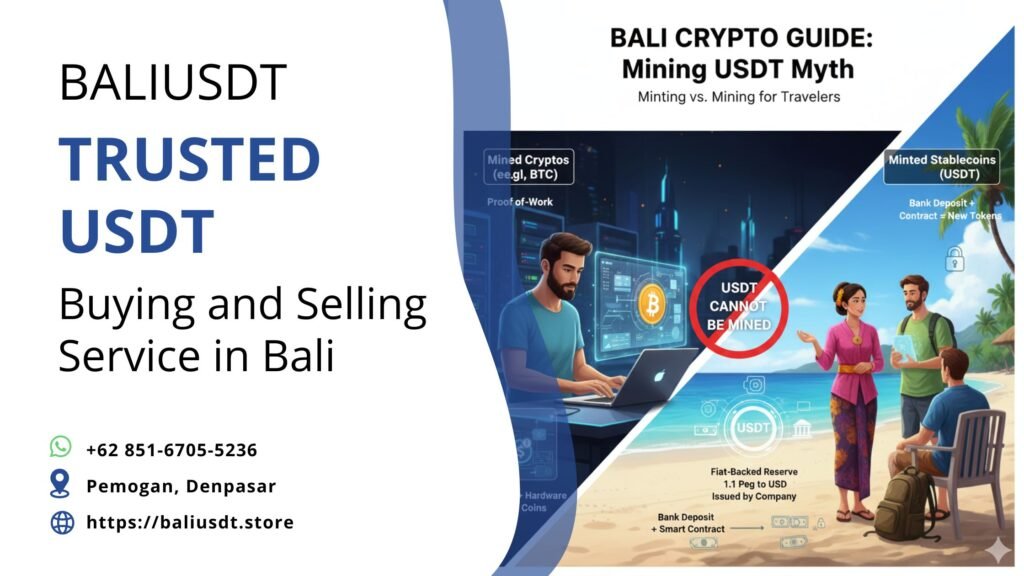
To effectively manage your funds, you must first understand why the answer to can USDT be mined is no. The stablecoin’s creation process is entirely different from the decentralized, computational process used by PoW cryptocurrencies.
Why Bitcoin is Mined (Proof-of-Work)
The term “mining” is associated with cryptocurrencies that use a Proof-of-Work (PoW) consensus mechanism, like Bitcoin. Mining involves:
- Solving Complex Puzzles: Miners use specialized, powerful hardware (ASICs or GPUs) to solve complex cryptographic equations.
- Validation: The first miner to solve the puzzle validates a block of transactions and adds it to the blockchain.
- Reward: The successful miner is rewarded with newly created tokens and transaction fees.
This process is computationally intensive, decentralized, and secures the network. It is about earning a token through verifiable work.
Why USDT is Minted (Fiat-Backed)
Tether (USDT) is a fiat-backed stablecoin. This means its value is tied to a traditional currency (the US Dollar) and is backed by reserves held by its issuer, Tether Limited.
- The Issuance Process: New USDT is created through a process called minting or issuance. When a user (typically an institution or exchange) deposits $1 USD into Tether Limited’s bank account, Tether’s smart contract issues (mints) 1 USDT token to the user’s digital wallet.
- Centralized Control: This is a centralized, on-demand process, not a decentralized, competitive one. The supply of USDT is directly controlled and regulated by the amount of fiat currency held in reserve.
Therefore, you cannot mine USDT because the token’s creation is a result of a direct fiat deposit and smart contract issuance, rather than solving mathematical proof-of-work puzzles. Recognizing this centralized backing is key to understanding the stablecoin’s mechanism.
Stability and Reliance: The USDT Reserve Mechanism
Since you cannot mine USDT, the token’s value stability rests entirely on the quality and quantity of the assets backing it. For the long-term traveler or expat, this reserve mechanism is the most critical factor for choosing USDT as a cross-border financial tool.
Maintaining the 1:1 Peg
The entire purpose of USDT is to maintain a 1:1 price peg with the US Dollar. This reliability is the primary reason why travelers use stablecoins: they can hold their digital wealth without the volatility typical of unpegged cryptocurrencies.
- Reserve Backing: Tether Limited maintains reserves, which they report include cash, cash equivalents, and other assets, to ensure they can honor redemption requests—the process of destroying 1 USDT and returning $1 USD.
- Liquidity: The vast liquidity and widespread adoption of USDT on exchanges globally make it highly efficient for cross-border transfer. This means the digital asset you hold is easily convertible back to fiat when you need it, which is the exact function required for financial management in Bali.
Alternative Earning Methods
While you cannot mine USDT, you can certainly generate passive income from your holdings while in Bali. These methods typically involve:
- Lending/Savings: Depositing your USDT into a centralized exchange’s savings account or a decentralized finance (DeFi) lending protocol to earn interest (yield) from borrowers.
- Liquidity Provision: Providing USDT to a decentralized exchange’s liquidity pool to earn trading fees.
These yield-generating strategies are the legitimate forms of passive crypto income for stablecoin holders, fundamentally distinct from the impossible task of attempting to mine USDT.
Compliance is Key: Selling Your USDT in Bali
For international travelers, the knowledge that you cannot mine USDT is a technical detail. The most important operational detail in Indonesia is regulatory compliance. Indonesia has a very clear, strict legal framework for digital assets.
The Indonesian Commodity Rule
The Indonesian government, through bodies like the Commodity Futures Trading Regulatory Agency (Bappebti) and the Financial Services Authority (OJK), classifies crypto assets, including USDT, as a tradable commodity, not legal tender. The only legal currency for all purchases and payments in Indonesia is the Indonesian Rupiah (IDR).
- Mandatory Conversion: This means any digital asset you bring, whether purchased or earned, must be converted into IDR cash before it can be used for daily expenses, such as paying for accommodation, transportation, or food.
- Avoiding Legal Risk: Tourists or businesses caught using crypto for direct payment face legal penalties, including fines and the potential for serious immigration consequences.
Therefore, the essential transaction for any traveler is the commodity sale—the legal process of selling your USDT for Indonesian Rupiah.
Safe and Legal Cash-Out Process
To ensure compliance and physical safety, foreign travelers should only use secure, reputable local exchange services for this conversion.
- Preparation: Ensure your USDT is on the most cost-effective network, typically Tron (TRC-20), for a quick, low-fee transfer to the exchange.
- Appointment: Contact a trusted exchange partner, perhaps one listed at BaliUSDT.store, and schedule a private, in-person meeting at their secure physical office.
- Secure Location: Conduct the exchange at their designated office, such as the one in Pemogan, Denpasar, which offers a protected environment away from public view.
- Transfer: Transfer the agreed-upon USDT amount from your private wallet to the exchange’s verified wallet address.
- IDR Handover: Upon confirmation of the transfer on the blockchain, you receive the full equivalent value in Indonesian Rupiah cash.
This professional, in-person service facilitates the safe and legal conversion of your digital commodity into local spending power.
Nomad Safety Tips Post-Exchange
Successfully navigating the digital finance landscape, from learning why you can USDT be mined is a misunderstanding to executing a secure commodity sale, is an achievement. However, the final safety check involves managing the physical cash you receive.
Discreet Management of Cash
After exchanging your USDT for IDR cash, you will be holding a large volume of Rupiah. Indonesian bank notes are large, and it is vital to be discreet:
- Secure Transport: Arrange private, pre-booked transport (like a Grab or Gojek car) directly from the exchange office back to your hotel or accommodation to secure the funds immediately. Avoid walking or using public transport while carrying large amounts.
- Use a Safe: Always utilize the safe provided in your accommodation for storing the bulk of the cash. Only carry the amount you need for a single day’s spending.
Cultural Tip: Pricing and Payments
Always use the IDR for price quotes and payments, and avoid attempting to haggle or pay with any foreign currency in tourist areas, as this can lead to confusion or overcharging. By consistently using the local currency obtained from your legal USDT sale, you demonstrate respect for Indonesian law and simplify your daily financial interactions.
Conclusion: Digital Sophistication, Local Compliance
The query, can USDT be mined, stems from a misunderstanding of stablecoin mechanics, but the correct answer—that USDT is minted against dollar reserves—highlights its centralized stability. For the international traveler in Bali, this stability is a powerful tool for cross-border financial management.
However, the key to a successful financial experience in Bali is unwavering compliance with local law. You must not use the USDT commodity as payment. By utilizing a secure, compliant service for the in-person sale of your digital assets, you legally and safely convert your digital wealth into the Indonesian Rupiah required for an enjoyable, worry-free stay on the Island of the Gods.
📲 WhatsApp us to sell your USDT safely: +62 851-6705-5236
Visit our office in Bali for secure USDT selling
Our office is located in Pemogan, Denpasar for secure, in-person transactions.
USDT is processed as a commodity sale in Indonesia, not as a direct payment method.
Read also : Can I Transfer USDT from Binance to Binance for Cash in Bali?