Introduction
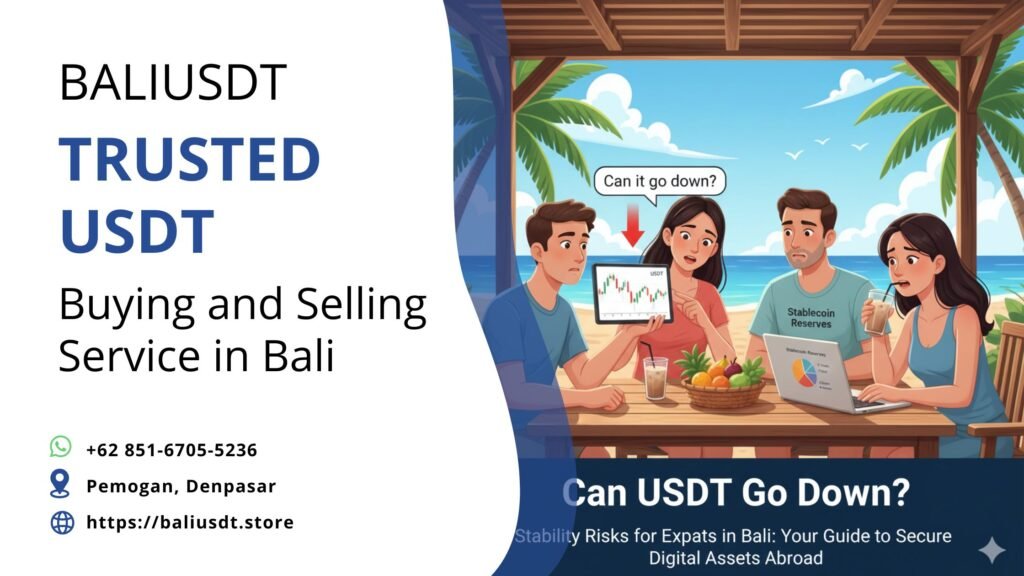
For digital nomads, expatriates, and long-stay travelers enjoying the vibrant life and unique culture of Bali, using stablecoins like Tether (USDT) for cross-border liquidity has become commonplace. However, as an international user, one must always ask the critical question: Can USDT go down in value? While USDT is designed to maintain a 1:1 peg with the US dollar, its stability is not guaranteed. Understanding the underlying mechanisms and risks is essential for anyone relying on this digital asset for their financial security while living on the Island of the Gods. This guide will clarify the reasons why Tether’s value might fluctuate and offer practical advice for minimizing your exposure to risk in the Indonesian market.
The Peg Mechanism: Understanding Tether’s Backing
Tether’s fundamental claim is that every token issued is backed by an equivalent value in reserves. The maintenance of the US$1 peg relies on two primary factors: the quality of the reserve assets and the mechanism of arbitrage.
Reserve Asset Quality and Liquidity
The quality of Tether’s reserve assets is the single most important factor determining whether can USDT go down. While the reserves include cash and cash equivalents like U.S. Treasury bills, they also contain less liquid assets, such as commercial paper and corporate bonds.
- Liquidity Challenge: If a market shock or loss of confidence triggers a massive wave of redemption requests—a digital “bank run”—Tether must sell its reserve assets quickly to pay out US dollars. Consequently, if the non-cash assets cannot be liquidated fast enough or must be sold at a discount, this creates a shortfall.
- Transparency Debate: Tether provides regular attestations regarding its reserves, confirming that assets exceed liabilities. However, these are not full, traditional audits, which fuels ongoing concerns among financial analysts about the true, instantaneous liquidity of the entire reserve pool. Therefore, any unexpected negative news regarding the reserves is a primary driver that could cause the price of USDT to momentarily slip.
The Arbitrage Defence
The primary force pulling the price back to US$1 is arbitrage. If the price of USDT drops to, say, US$0.95 on an exchange, large institutional traders can purchase the cheap USDT and then redeem it directly with Tether for the full US$1, locking in a profit. This intense buying pressure restores the peg. **Conversely**, if the price rises above US$1, traders print new USDT from Tether at US$1 and sell it on the exchange for a profit, driving the price down. This mechanism is powerful, but it relies on Tether’s ability to always process redemptions quickly and fully.
Real-World Risks: Scenarios Where Can USDT Go Down
Despite its robust market defenses, history shows that the USDT peg is not unbreakable. For foreign residents in Bali, understanding these historical precedents and potential risks is key to proactive financial planning.
1. Loss of Market Confidence (The Bank Run)
This is the most significant and immediate risk. If a major regulatory action, a large market scandal, or a significant financial failure elsewhere in the crypto ecosystem causes investors to suddenly lose faith in Tether’s ability to honor redemptions, panic selling will commence. For instance, during the broader crypto market sell-offs, selling pressure on exchanges has pushed USDT below its peg, as observed in historical events like 2018 and during the Terra/LUNA crisis. When institutional investors are unwilling or unable to utilize the arbitrage opportunity, the price can USDT go down temporarily until confidence returns or Tether intervenes.
2. Regulatory or Legal Intervention
Tether operates globally, subjecting it to various and often conflicting regulatory demands. A significant legal ruling or a major regulatory penalty in a key jurisdiction could lead to a freeze or seizure of reserve accounts. Hence, even if the reserves are technically solvent, an inability to access them due to legal constraints could halt redemptions, leading to a severe de-pegging event. Indonesia itself has strict rules on the use of foreign currencies and crypto as payment, which while not directly impacting the peg, underscores the sensitive nature of global financial regulations.
3. Liquidity Crisis in Reserve Assets
If Tether’s non-cash assets (such as commercial paper) suffer a massive, systemic markdown during a global financial crisis, the total value of Tether’s backing could fall below its total liabilities. Therefore, the answer to can USDT go down becomes a question of solvency in a worst-case scenario. While Tether’s management has generally been proactive in diversifying and increasing the liquidity of its reserves, a sudden economic downturn could still put its non-Treasury assets under significant strain.
Navigating Bali: Practical Financial Security for Foreigners
Living in Bali offers a beautiful lifestyle, but it requires diligent attention to personal finance, especially when using digital assets. The local context, particularly Indonesian law, adds another layer of complexity.
Legal Compliance and Local Currency
The most important local rule for foreigners is that the Indonesian Rupiah (IDR) is the only legal tender for all transactions in Indonesia. The use of foreign currencies or crypto assets like USDT for direct payments is strictly prohibited. Consequently, if you hold USDT, its use in Bali must be limited to converting it legally and securely into IDR. This legal necessity makes the stability of the exchange rate between USDT and US dollar, and subsequently IDR, vital.
Mitigating Risk and Ensuring Access to Funds
- Diversify Stablecoins: Avoid placing 100% of your liquidity in a single stablecoin. A diverse portfolio that includes other major, regulated stablecoins (like USDC) can mitigate the risk of an issuer-specific failure causing your total capital to drop.
- Maintain IDR Liquidity: Always keep a reasonable buffer of Indonesian Rupiah in a local bank account or cash. This emergency fund ensures you can cover essentials like accommodation, visa fees, and transport (e.g., in Seminyak or Canggu) even if the crypto market, for any reason, experiences a temporary crisis and your USDT is inaccessible or its value dips.
- Use Trusted Conversion Services: When it is time to convert your USDT to IDR, use only reputable local service providers with a track record of transparent, secure operations. Providers who offer physical office locations, such as those in Pemogan, Denpasar, often add a layer of trust and security that P2P exchanges cannot match. Furthermore, utilizing established services, like those offered at BaliUSDT.store, ensures you comply with local regulations while getting a competitive rate.
The Long-Term Outlook: Why USDT Often Recovers
Despite the valid concerns and the historical volatility, USDT has repeatedly demonstrated strong resilience and the ability to restore its peg, which is why it remains the dominant stablecoin.
Market Dominance and Liquidity
Tether’s sheer market size and its pervasive use across nearly every major crypto exchange give it a massive advantage. Its trading volume often exceeds that of all other stablecoins combined, guaranteeing that arbitrageurs can operate at scale. This deep liquidity acts as a powerful self-correcting mechanism. Thus, while the value can USDT go down briefly, the forces of arbitrage are very quick to restore the US$1 peg to profit from the temporary discrepancy.
Issuer Motivation and Financial Strength
Tether is highly motivated to maintain the peg; its entire business model depends on it. Moreover, the company’s recent financial reports suggest a substantial equity buffer beyond the declared reserves, which could be used to absorb losses or shore up confidence during periods of extreme stress. In fact, the market’s response to the 2022 de-pegging events demonstrated that Tether’s system is fundamentally robust, even if not entirely impervious to panic.
Conclusion
The answer to the question, can USDT go down, is a qualified “yes.” While the token is backed by assets and protected by powerful market mechanics, a temporary de-pegging event is a historical reality driven by loss of confidence, regulatory risk, or liquidity concerns. For travelers and expats in Bali, such an event, even if short-lived, can create immediate financial inconvenience and loss of purchasing power in IDR. Therefore, the prudent strategy is to adopt diversification, maintain a local IDR buffer, and partner with highly secure, transparent local services for all your conversion needs. By staying informed and cautious, you can confidently integrate digital assets into your life in Indonesia while minimizing the inherent market risks.
📲 WhatsApp us to sell your USDT safely: +62 851-6705-5236
Visit our office in Bali for secure USDT selling
USDT is processed as a commodity sale in Indonesia, not as a direct payment method.
Read also : Can USDT Fail? A Crucial Guide for Expats in Bali