For the modern traveler, expat, or digital nomad utilizing stablecoins like Tether (USDT) for global finance, the question, can USDT transactions be traced, is not just about curiosity—it is fundamentally about security, compliance, and financial privacy. The perception of cryptocurrency transactions is often one of complete anonymity. However, the reality of public blockchain technology reveals a system of pseudonymity, where transactions are transparently recorded but are linked to alphanumeric wallet addresses, not directly to real-world identities.
This transparency is the defining feature of the blockchain and has significant implications for anyone managing digital assets, especially when converting those assets into the local currency of a country with strict financial regulations, like Indonesia. Understanding the traceability of your USDT is crucial for making informed decisions about wallets, transfers, and, most importantly, the compliant process of converting your digital commodity into Indonesian Rupiah (IDR) cash for your life on the Island of the Gods. This comprehensive guide will clarify blockchain traceability and outline the safest, most legal methods for using your funds in Bali.
The Truth About Blockchain: Transparency Over Anonymity
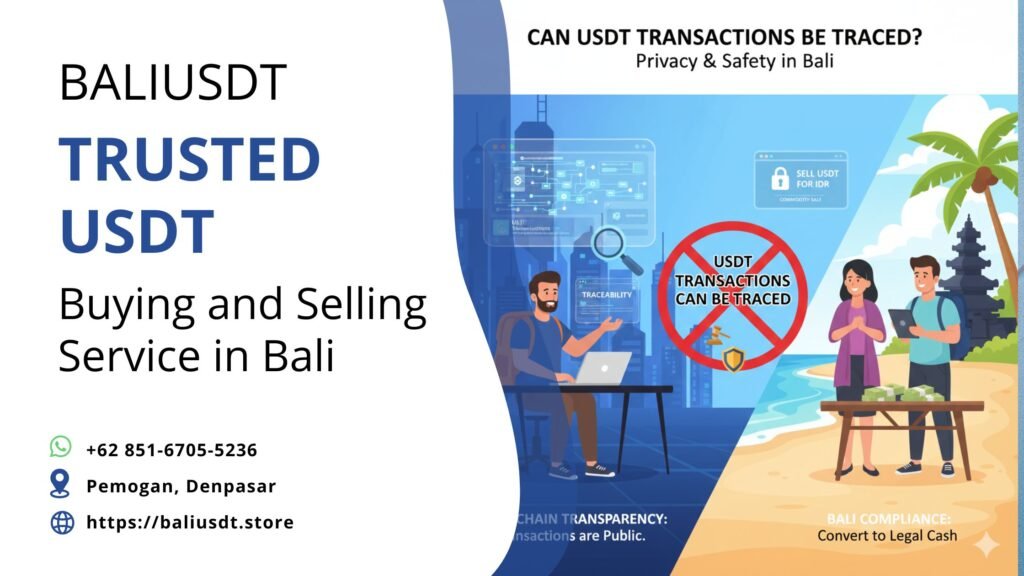
To directly address the query, can USDT transactions be traced, the answer is unequivocally yes. The underlying technology of the blockchain—whether it is Ethereum (ERC-20), Tron (TRC-20), or BNB Smart Chain (BEP-20)—is designed for transparency and immutability.
The Public Ledger Principle
USDT, being a token issued on these public blockchains, adheres to their rules:
- Open Record: Every transaction—including the sender’s address, the recipient’s address, the amount of USDT transferred, and the time stamp—is permanently recorded on the blockchain ledger and is visible to anyone using a public blockchain explorer (like Tronscan or Etherscan).
- Immutability: Once a transaction is confirmed, it can never be altered or deleted. This immutability ensures a verifiable history that any regulator or service can audit.
- Pseudonymity: While the transactions are visible, the wallet addresses are strings of code (pseudonyms), not names. This provides a layer of separation, but it is not true anonymity.
Therefore, the movement of your USDT from wallet to wallet is highly traceable. The challenge for analysts lies in connecting that pseudonymous wallet address to a real-world person, which is where centralized exchanges and analytics firms come into play.
The Role of Centralized Exchanges (CEXs)
Most travelers acquire or off-ramp their crypto through Centralized Exchanges (CEXs) like Binance or Coinbase, which are legally mandated to enforce Know-Your-Customer (KYC) and Anti-Money Laundering (AML) regulations.
When a wallet address deposits funds into, or withdraws funds from, an exchange where KYC has been completed, that wallet address becomes linked to a verified identity. This interaction essentially provides a crucial link in the chain, making it significantly easier to definitively prove that USDT transactions can be traced back to a specific individual.
💻 Blockchain Forensics and Analytics
The traceability of USDT is not just limited to viewing transactions on a simple block explorer. Sophisticated forensic tools and blockchain analytics platforms actively monitor and analyze these public ledgers.
Tools for Advanced Tracing
Companies specializing in blockchain analysis employ advanced algorithms to follow the flow of digital assets across multiple wallets and exchanges:
- Clustering Analysis: Analysts identify clusters of wallet addresses that likely belong to the same entity or individual by observing patterns of activity (e.g., spending from multiple inputs to a single output).
- Cross-Chain Tracing: USDT exists on multiple blockchains. Forensic tools can track funds as they move through “bridges” or decentralized exchanges (DEXs) from one network (like Ethereum) to another (like Tron).
- Sanction Screening: USDT issuer, Tether Limited, actively cooperates with law enforcement and analytics firms to monitor and freeze tokens in wallets associated with illicit activities. This demonstrates not only that USDT transactions can be traced but also that they are subject to centralized control, a power that Bitcoin does not possess.
The implications for the international traveler are clear: all your on-chain financial activity leaves a permanent, traceable digital footprint.
The Compliance Connection: Traceability and Indonesian Law
Understanding that can USDT transactions be traced is essential because it impacts how you handle your funds in the highly regulated environment of Indonesia. For travelers and expats in Bali, financial compliance must be the top priority.
USDT as a Regulated Commodity
Indonesia’s financial regulations, enforced by agencies like Bappebti, classify USDT and other cryptocurrencies as a tradable commodity, not legal tender. The law strictly requires that all payments in Indonesia be conducted in the Indonesian Rupiah (IDR).
- Risk Management: The traceability of USDT means that any transaction—no matter how small—attempted as a direct payment for goods or services can be identified on the blockchain. If a local vendor is linked to an illegal crypto payment, the transaction can be publicly exposed, posing a significant legal risk to both the vendor and the foreigner involved.
- Legal Requirement: The only legal action for a traveler is the commodity sale—selling your USDT for IDR cash. This process is fully compliant and transparent.
Ensuring a Traceable (and Safe) Final Transaction
Paradoxically, when selling your USDT for cash in Bali, you want the transaction to be transparent and traceable. This is because a verifiable, recorded transfer to a reputable exchange’s corporate wallet provides an immutable audit trail of a legal commodity sale.
By utilizing a professional service, such as one found at BaliUSDT.store, you ensure that the transaction follows the proper legal framework. This involves an in-person exchange at a secure office, such as their location in Pemogan, Denpasar, where the transfer is made to a known entity and recorded, thereby legitimizing the source of your IDR cash.
Best Practices for Travelers Managing Traceable Assets
For a digital nomad, mitigating the risks associated with the fact that USDT transactions can be traced involves smart digital hygiene and careful local execution.
Digital and Physical Security Tips
- Wallet Management: Use a private, self-custody wallet (e.g., Trust Wallet or MetaMask) for your main travel funds, minimizing the interaction with CEXs while abroad. Only use a minimal “spending wallet” for small transfers.
- Network Choice: For transfers to local exchanges, use the low-fee Tron (TRC-20) network. It offers high transparency, which is good for a commodity sale audit trail, but minimizes transaction costs.
- Post-Exchange Safety: After the legal commodity sale in Pemogan, Denpasar, you will have cash. Use a secure form of transport (e.g., ride-hailing app) directly to your secure accommodation to minimize the risk associated with carrying large amounts of IDR.
Cultural and Legal Note
Always respect the local legal environment. Never pressure a local vendor to accept crypto. Your commitment to using the IDR, obtained compliantly from your USDT commodity sale, is the greatest sign of respect for Balinese law and culture.
Conclusion: Transparency is Security
The core truth for any international resident is that can USDT transactions be traced is answered with a firm affirmative due to the transparent nature of public blockchains. For the informed traveler, this transparency is not a threat, but a tool for ensuring financial security and regulatory compliance.
By acknowledging the traceability of your digital assets and utilizing secure, compliant, in-person services for the legal commodity sale of your USDT, you successfully navigate the legal environment of Indonesia. This disciplined approach ensures your focus remains where it belongs: on enjoying the rich experience of living and working on the Island of the Gods.
📲 WhatsApp us to sell your USDT safely: +62 851-6705-5236
Contact our team for USDT selling assistance
Our office is located in Pemogan, Denpasar for secure, in-person transactions.
USDT is processed as a commodity sale in Indonesia, not as a direct payment method.
Read also : Can USDT Be Mined? Dispelling the Myth for Travelers in Bali