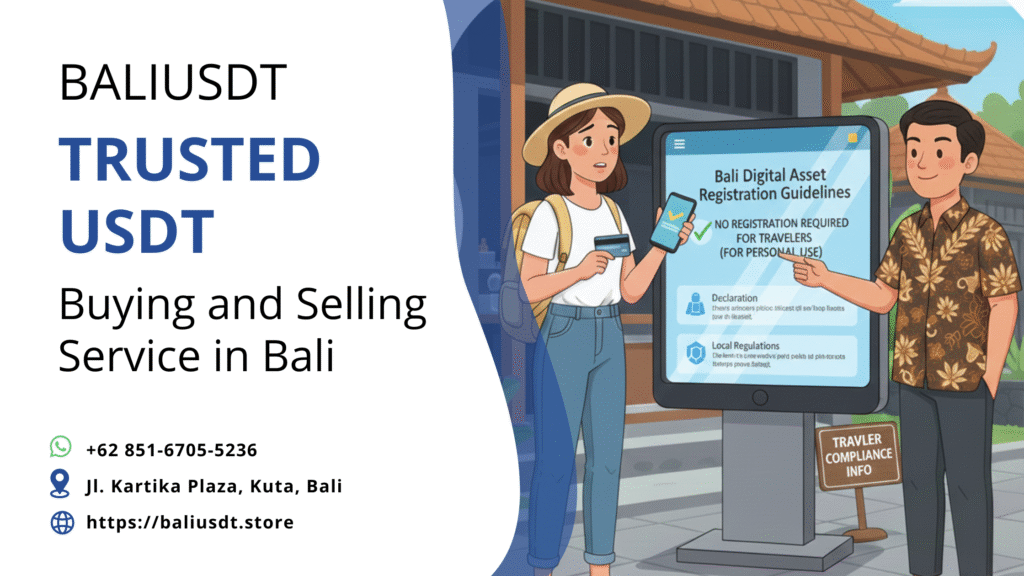
For the globally mobile community, from digital nomads to long-term expats, managing borderless digital assets like Tether (USDT) is a daily necessity. Consequently, a vital compliance and security question often arises when landing in Bali: do i need to register to use usdt? The definitive answer depends on how you plan to use it. While holding USDT in your private, self-custody wallet does not require registration, any transaction involving a local exchange, a P2P platform, or a professional service to convert that USDT into Indonesian Rupiah (IDR) will trigger mandatory registration and Know Your Customer (KYC) requirements under strict Indonesian financial laws. Understanding this distinction is crucial for enjoying your stay while remaining compliant with Indonesia’s evolving regulatory framework.
The Difference Between Holding and Transacting USDT
To fully grasp the registration requirements, you must first distinguish between simply holding your crypto and actively transacting with it through a regulated service.
Self-Custody: No Registration Required
If you are merely holding USDT in a non-custodial wallet (like MetaMask, Trust Wallet, or a hardware wallet like Ledger), where only you control the private keys, you are simply storing an asset.
- Decentralized Freedom: The essence of decentralized finance (DeFi) is that your wallet operates outside the control of any central authority or government registry. In this scenario, do i need to register to use usdt with the Indonesian government? The answer is no; you are not interfacing with the local financial system.
- Risk vs. Regulation: This freedom comes with the responsibility of securing your private keys. The government cannot freeze your wallet, but neither can they help you if you lose access or fall victim to a scam.
Interacting with the Local Financial System: Registration is Mandatory
The moment you attempt to convert your USDT to spendable Rupiah (IDR) using a service provider, you are entering the regulated Indonesian financial ecosystem. The question do i need to register to use usdt becomes an emphatic yes.
- Exchanges and Service Providers: Any entity providing crypto-to-fiat conversion services in Indonesia—be they domestic exchanges, P2P platforms, or local facilitators—is classified as a Virtual Asset Service Provider (VASP).
- KYC/AML Compliance: VASPs are legally obligated to enforce stringent Anti-Money Laundering (AML) and Counter-Terrorism Financing (CTF) protocols, which mandate full Customer Due Diligence (CDD), meaning you must register and complete KYC.
Therefore, for any practical use that impacts your travel funds, you will encounter mandatory registration.
KYC Requirements for Foreigners in Bali
The registration process for a foreign national typically requires more documentation than for a local citizen, reflecting the need for rigorous international compliance.
What Documents Are Needed for USDT Registration?
Whether you use a large international exchange or a local Indonesian platform for selling crypto, the fundamental KYC requirements remain the same:
- Passport: A clear, valid copy of your passport is the primary document used for identity verification.
- Proof of Address: This often requires a recent utility bill, bank statement, or official letter showing your name and permanent foreign address.
- Biometric Verification: Most modern platforms require a “selfie” or a short video of you holding your passport to prove liveness and prevent identity theft.
Registration for Local Bank Transfers (IDR)
If your goal is to successfully sell your USDT and withdraw the Rupiah to an Indonesian bank account, the registration requirements are stricter. To open a local Indonesian bank account, short-term travelers typically need a social or business visa, or a Limited Stay Permit (KITAS). Without a local bank account, your ability to efficiently sell crypto for IDR is limited to P2P or local cash facilitators.
It is critical to note that Indonesian regulations, including the FATF Travel Rule, require the collection of specific sender and recipient information for all crypto transactions, especially those exceeding US$1,000. This is the government’s way of ensuring that every entity asking do i need to register to use usdt for larger transactions provides necessary data.
The Compliant Path: Using Trusted Local Facilitators
For travelers and digital nomads focused on convenience, speed, and safety in Bali, using the services of a professional local facilitator can simplify the process of crypto-to-fiat conversion while ensuring compliance.
Why Choose a Local, Registered Service?
A reputable local service acts as a secure, regulated bridge between your decentralized assets and the centralized Indonesian banking system. They handle the conversion and often the associated tax withholding.
- Streamlined KYC: While you still must complete KYC for the service provider (as they must comply with OJK regulations), the process is often more human-centric and less prone to the automated rejection errors common on massive international exchanges.
- Legal Compliance: Local service providers ensure that the commodity sale transaction is recorded and executed in accordance with Indonesian law. This gives you peace of mind that your conversion into IDR is compliant.
- Security on the Ground: Using a professional office, rather than meeting an anonymous P2P trader, drastically reduces the personal security risk when handling large transactions or cash withdrawals in popular areas like Canggu or Seminyak.
By utilizing a service like BaliUSDT.store, you delegate the complexity of local financial regulatory hurdles to experts who know the exact requirements. This answers the question of do i need to register to use usdt for conversion with a reassuring “yes, but it’s easy and secure through us.”
Navigating International vs Domestic Registration
Many foreigners continue to use their registered accounts on large international exchanges (like Binance or Kraken) while in Bali. This is legal, but it introduces complications.
International Exchanges (Foreign-Registered)
If you completed KYC with a global exchange outside of Indonesia, you don’t need to re-register that specific account in Bali. However:
- IDR Withdrawal Friction: You will struggle to withdraw IDR directly, as these platforms may not support direct transfers to Indonesian banks or may have high foreign wire fees.
- Tax Self-Assessment Risk: Indonesia’s tax regulations incentivize using domestic platforms (lower tax rate). If you sell on a foreign platform that is not appointed as a tax collector, the obligation to report and pay the 1% Final Income Tax falls entirely on you (self-assessment). This adds significant complexity for a traveler trying to determine do i need to register to use usdt and comply with local tax reporting.
Domestic Exchanges (OJK/BAPPEBTI-Registered)
If you plan to live in Indonesia long-term, opening an account with a local, regulated exchange is the most compliant route. This will require full registration, including a local ID and Indonesian Tax Number (NPWP), which are difficult for tourists to obtain. This path definitively settles the question, do i need to register to use usdt, as registration is the prerequisite for accessing the low domestic tax rate.
Therefore, for the short-term traveler, the use of a local facilitator who handles the compliant conversion for you remains the most practical and least bureaucratic option.
Best Practices for Secure and Compliant USDT Use
Whether your goal is to hold, send, or sell your USDT in Bali, these steps will ensure maximum safety and compliance.
- Use a Secure Wallet: If you are simply holding assets, ensure your private keys are secured, ideally on a hardware wallet.
- Validate Service Providers: Only conduct conversions or sales with established, verified local businesses or exchanges. Check their reputation within the expat community.
- Rupiah Only: Remember the cardinal rule: using any currency other than the Indonesian Rupiah (IDR) for payment for goods or services in Bali is illegal. USDT must be sold for IDR before spending. This legal restriction fundamentally reinforces why you need to register and use compliant channels when you ask, do i need to register to use usdt for local use.
- Keep Records: Maintain meticulous records of all conversion and sale transactions, including any fees or taxes withheld.
By following these guidelines, you can navigate Indonesia’s crypto landscape with confidence, turning the complex legal query of do i need to register to use usdt into a manageable operational step.
Conclusion
The answer to do i need to register to use usdt in Bali is contingent upon your activities. No registration is needed for self-custody wallets, but full KYC registration (with your passport) is legally mandatory when selling USDT through any exchange or service to convert it into usable Indonesian Rupiah (IDR). This requirement is an integral part of Indonesia’s strict AML/KYC laws. For maximum convenience and compliance, especially for short-term visitors, using a professional local facilitator who handles the required documentation and safe conversion process is the recommended method.
📲 WhatsApp us to sell your USDT safely: +62 851-6705-5236
Check today’s USDT selling rate via Whatsapp
Get guidance for selling USDT legally in Indonesia
Visit our office in Bali for secure USDT selling
Pemogan, Denpasar.
USDT is processed as a commodity sale in Indonesia, not as a direct payment method.
Read also: What is the Difference Between USDT and USDC? Bali Guide