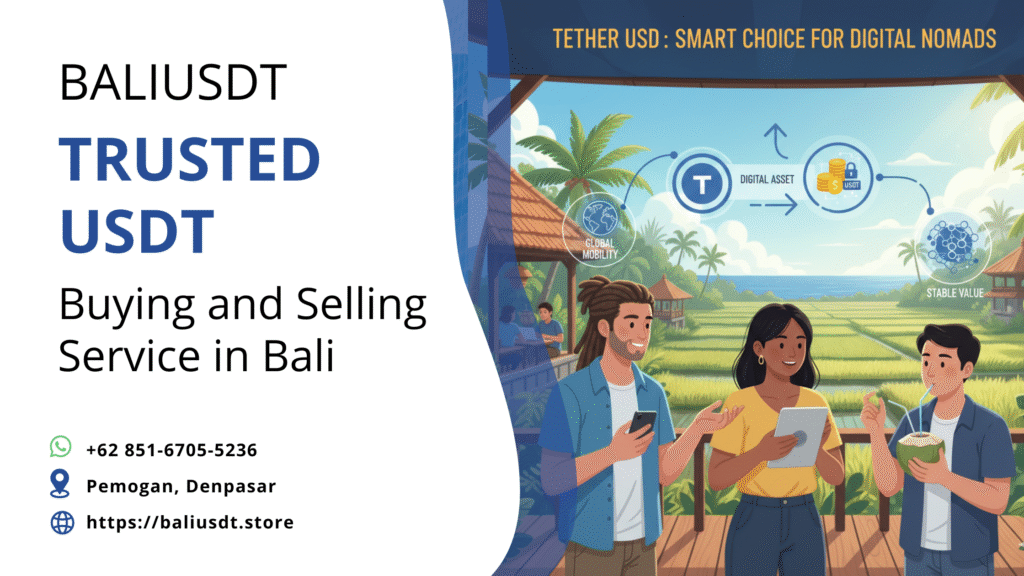
For the international community, particularly digital nomads and travelers planning extended stays in dynamic economies like Indonesia, understanding how does Tether USDT work is essential. USDT, or Tether, is the world’s largest stablecoin. It functions by combining the stability of the US Dollar (USD) with the speed and borderless nature of blockchain technology. This unique synergy makes it the go-to financial instrument for moving money across international borders efficiently, minimizing the high fees and lengthy delays associated with traditional banks. By grasping the mechanics of USDT, travelers gain an indispensable tool for protecting their funds and managing liquidity seamlessly anywhere in the world.
The Core Principle: Maintaining the $1.00 USD Peg
The central element in answering how does Tether USDT work is its fundamental goal: price stability. Unlike volatile cryptocurrencies, USDT is designed to maintain a 1:1 value ratio with the US Dollar.
The Fiat-Collateralized Reserve System
Tether achieves its price stability through a fiat-collateralized reserve system. This means that every single USDT token issued into circulation is theoretically backed by an equivalent value of assets held in reserve by the issuer, Tether Limited.
- Reserve Composition: These reserves consist primarily of highly liquid, low-risk assets. This includes cash and cash equivalents, short-term US Treasury bills, and commercial paper. Consequently, the backing is a mix of assets, not just physical US Dollars in a vault.
- Issuance and Redemption: When a large customer (like an exchange or institution) deposits $1 USD into Tether’s bank account, Tether mints and issues 1 USDT token to that customer’s digital wallet. Conversely, if a customer wants to redeem their USDT for USD, Tether removes the equivalent tokens from circulation (burns them) and sends $1 USD back to the customer. This process of minting and burning tokens keeps the supply balanced with demand, which helps keep the price anchored at $1.00.
The Role of Market Arbitrage
The stability mechanism works even on the open market. When the price of USDT drops slightly below $1.00 (say, to $0.99), professional traders see an opportunity. Since they know how does Tether USDT work via redemption, they buy the cheap USDT and redeem it directly from Tether for the full $1.00, instantly making a profit. This action—buying cheap USDT—increases demand and quickly pulls the market price back up to the peg.
USDT’s Digital Infrastructure: Blockchain Networks
USDT does not operate on its own dedicated blockchain. Instead, it exists as a token built on top of various existing blockchain networks. This multi-chain support is fundamental to understanding its efficiency for global travel.
Multi-Chain Support for Flexibility
Originally, USDT was issued on the Bitcoin blockchain via the Omni Layer protocol. However, today, it is available on numerous networks, including:
- Ethereum (ERC-20): The original smart contract standard. It is secure, but transaction fees (known as gas fees) can be very high, and confirmation times can be slow during peak usage.
- Tron (TRC-20): This is the most popular network for travelers and daily transactions. Since fees are typically less than $1 USD and settlement is nearly instant, TRC-20 offers unmatched convenience for cross-border fund transfers.
For a traveler using USDT to manage funds for a trip to Bali, choosing the TRC-20 network is highly recommended. This technical detail drastically reduces the cost of moving money around the globe.
Fast, Borderless Transfers
When you transfer USDT, you are simply broadcasting a command on the blockchain network of your choice (e.g., Tron). Therefore, the funds move digitally from one wallet address to another, entirely independent of traditional banking hours or international transfer protocols. This high speed and low cost are precisely how does Tether USDT work to beat slow, expensive SWIFT bank transfers.
Practical Application: USDT as a Traveler’s Currency Bridge
For the expat or digital nomad, USDT serves as a critical currency bridge. It bridges the gap between their home fiat currency (like the Australian Dollar or Euro) and the local fiat currency (like the Indonesian Rupiah).
The On-Ramp and Off-Ramp Process
To initiate the process, a traveler first converts their home currency into USDT via a centralized exchange (the ‘on-ramp’). They hold the funds in a secure, non-custodial wallet. When they arrive in their destination, the process reverses: they sell their USDT to a local exchange service for cash (the ‘off-ramp’).
- Securing Purchasing Power: By holding USDT, the traveler secures their spending power in US Dollars, isolating themselves from potential volatility in the local Rupiah. They only convert the amount of IDR they need for a week or two.
- Cost Efficiency: The low transfer fees via TRC-20 ensure maximum value retention. The final exchange with a reputable local service (like those operating in Pemogan, Denpasar) often provides a better exchange rate than traditional money changers.
Local Tip: Selling Compliantly
When using USDT to fund a trip, you must remember a crucial legal note. In Indonesia, you cannot use USDT to pay directly for goods or services. The process involves selling your USDT (as a commodity) to a legal exchange for Rupiah, which you then use for local payments. For secure and compliant selling assistance in Bali, you can use trusted local services. You can learn more about this process and check competitive rates at BaliUSDT.store.
Security, Convenience, and Due Diligence
Understanding how does Tether USDT work is incomplete without acknowledging the aspects of security and convenience that make it ideal for international travelers.
Security and Decentralized Control
Since your USDT is held in a non-custodial wallet, you retain full control over your private keys. This gives you ultimate financial security. Unlike a bank account, no third party can freeze your assets, offering protection against unforeseen banking issues while abroad. However, this also means you carry the sole responsibility for protecting your private keys. Therefore, always secure your wallet with strong passwords and two-factor authentication.
Operational Convenience
The convenience of using USDT is undeniable. Furthermore, you do not need to visit a physical bank or ATM to access your funds. All you need is a smartphone and an internet connection. This digital accessibility is particularly valuable for travelers venturing outside major metropolitan areas or when banks are closed. The operational simplicity is a major reason why how does Tether USDT work for global financial management.
Conclusion
How does Tether USDT work? It works as a dollar-pegged digital token backed by liquid reserves, enabling instant, low-cost value transfer across any blockchain that supports it. For the international traveler, this mechanism translates to financial stability, high security, and unmatched operational convenience, particularly when leveraging the efficiency of the TRC-20 network. By choosing to hold and manage your travel funds using USDT and utilizing trusted, compliant local exchange services, you ensure a financially smooth and cost-effective experience in any foreign country.
Check today’s USDT selling rate via Whatsapp
📲 WhatsApp us to sell your USDT safely: +62 851-6705-5236
Visit our office in Bali for secure USDT selling: Pemogan, Denpasar
USDT is processed as a commodity sale in Indonesia, not as a direct payment method.
Read also: How Can I Buy USDT in Australia? Safe and Fast Method