If you are currently relaxing in a beachfront villa in Canggu, you might be wondering how is usdt pegged to the US Dollar so reliably while other digital assets swing wildly in price. For the thousands of digital nomads and expats who have made Bali their home in 2026, Tether (USDT) has become a primary tool for financial stability. Unlike Bitcoin, which can change in value while you are riding a scooter from Seminyak to Ubud, USDT is designed to stay at exactly one dollar. This stability is not magic; it is the result of a sophisticated financial mechanism that combines massive physical reserves with the invisible hand of global market arbitrage.
The Reserve Mechanism: The Foundation of Stability
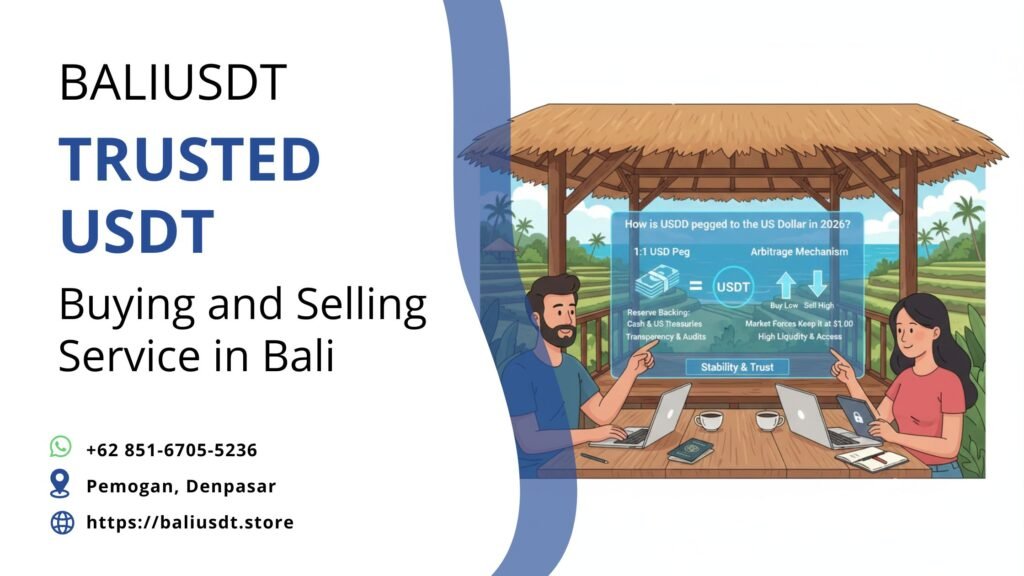
The primary way how is usdt pegged to its value is through a 1:1 reserve system managed by Tether Limited. By 2026, Tether has significantly modernized its transparency practices to comply with international standards. For every single USDT token issued on a blockchain—whether it is Tron, Ethereum, or Solana—Tether holds an equivalent amount of value in its global reserves. These reserves are not just piles of cash; they consist of highly liquid assets like U.S. Treasury bills, which are essentially government-backed “IOUs” that earn interest.
For an expat living in Bali, this means your digital assets are backed by the same safe-haven assets used by major global banks. In 2025, the U.S. Genius Act established even stricter rules for stablecoin issuers, requiring them to segregate reserve assets from their own corporate funds. This regulatory evolution has given travelers more confidence than ever that their digital commodities can be converted back into traditional currency whenever they need to pay for a long-term villa rental or an unexpected medical bill.
Arbitrage: How the Market Corrects Itself
While reserves provide the “floor” for the value, market arbitrage is the engine that keeps the price at exactly $1.00 on various exchanges. To understand how is usdt pegged in real-time, you have to look at how traders react to tiny price differences. If the price of USDT on an exchange like Indodax drops to $0.99 due to high selling pressure in Bali, professional traders will immediately buy it. They then take those tokens and redeem them directly with Tether for the full $1.00, pocketing a 1% profit.
This constant buying and selling—known as arbitrage—automatically pushes the price back to its peg. Conversely, if the price rises to $1.01 because everyone in Uluwatu is trying to buy USDT at once, traders will mint new tokens with Tether at $1.00 and sell them on the market for $1.01. This “invisible hand” ensures that the asset stays within a tiny fraction of its target price, providing the predictability you need to manage your monthly “nomad budget” without stress.
Why Bali Travelers Choose USDT Over Volatile Assets
Modern travelers in Indonesia choose stablecoins because they offer the best of both worlds: the speed of blockchain and the stability of the dollar. When you know how is usdt pegged, you realize it is a much safer place to store your travel savings than in a traditional local bank account that might be subject to high inflation or currency devaluation.
- Predictable Spending: You can calculate your monthly expenses for Gojek, coworking spaces, and gym memberships without worrying about market crashes.
- Low-Cost Remittances: Sending money from Europe or the US to Bali via USDT is significantly cheaper than using legacy banking systems.
- Emergency Funds: Having a stable asset that you can liquefy in minutes at a local office provides a vital safety net for expats.
Converting Your Assets Legally in Indonesia
In 2026, it is important to remember that the Indonesian government treats USDT as a commodity, not as a legal payment method. You cannot walk into a local warung and pay for your Nasi Jinggo with digital tokens. Instead, you must sell your commodity for Indonesian Rupiah (IDR). Because you understand how is usdt pegged, you know that the value you receive will always be fair based on the current USD/IDR exchange rate.
To ensure your safety and compliance with local laws, it is always recommended to use professional services like BaliUSDT.store. Using a professional “Over-the-Counter” (OTC) desk in areas like Pemogan or Denpasar is far safer than meeting strangers from social media groups. A professional service provides a secure environment where you can receive your Rupiah via a local bank transfer or cash, ensuring that your transaction is documented and safe from common street scams.
Practical Tips for Digital Nomads in Bali
Living the high-tech, low-stress life in Bali requires more than just knowing how is usdt pegged. You also need to navigate the local infrastructure with care.
- Use a Secure VPN: Never access your exchange or wallet on public Wi-Fi in Canggu or Seminyak without protection.
- Verify the Network: Most local services in Bali prefer the TRC20 (Tron) network because it is fast and has very low fees.
- Local Manners: When visiting a physical exchange office, remember that Balinese culture values politeness. A simple “Suksma” (Thank you) goes a long way.
- ATM Awareness: If you are using an ATM to withdraw your converted Rupiah, always check for skimming devices and use machines located inside bank branches.
By combining your knowledge of stablecoin mechanics with these local safety tips, you can enjoy everything the Island of the Gods has to offer, from the sunrise at Mt. Batur to the nightlife of Kuta, with total financial peace of mind.
Conclusion
Understanding how is usdt pegged is the key to mastering your finances as an international traveler in 2026. The combination of 1:1 reserves, strict regulatory oversight, and constant market arbitrage ensures that Tether remains a reliable “digital dollar.” This stability allows you to focus on your work and your adventures, rather than worrying about the fluctuating value of your wallet.
Bali is an island of magic and tradition, but it is also a place where modern technology can make your life significantly easier. By holding your wealth in a stable commodity and using trusted local partners to access the local economy, you can ensure your stay in Indonesia is as smooth and beautiful as a Balinese sunset.
Ready to Sell Your USDT Safely in Bali?
If you are currently in Bali and need to convert your digital assets into local Rupiah for your villa, transportation, or daily adventures, our team is here to provide a professional and secure experience.
Visit our office in Bali for secure USDT selling
Our Office Location:
Pemogan, Denpasar
📲 WhatsApp us to sell your USDT safely: +62 851-6705-5236
USDT is processed as a commodity sale in Indonesia, not as a direct payment method.
Read also : How is USDT minted and issued to the crypto market?