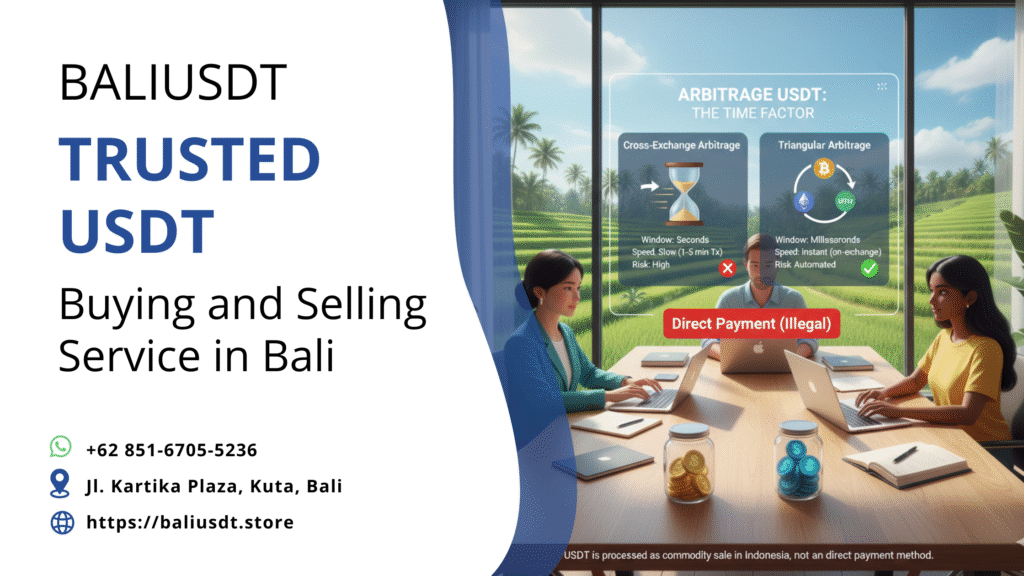
For finance-savvy travelers, digital nomads, and experienced expats based in global markets like Bali, cryptocurrency arbitrage is often a topic of intense interest. Consequently, a natural question arises concerning the operational execution of these strategies: how long arbitrage USDT opportunities typically last, and what factors determine the time frame for a successful trade? Arbitrage, which involves capitalizing on the small price differences for an asset (like USDT) across various exchanges or markets, is fundamentally a race against time. Given that USDT is a stablecoin designed to maintain its $\$1.00$ peg, arbitrage opportunities usually arise from temporary market inefficiencies, which, by their very nature, are extremely short-lived. Successfully executing these trades requires speed, precision, and an intimate understanding of the technical and logistical bottlenecks inherent in cross-exchange or cross-platform transfers.
The Fleeting Window: How Long Arbitrage USDT Opportunities Exist
The answer to how long arbitrage USDT opportunities exist is, universally, “not long.” The digital financial ecosystem is highly efficient, meaning price discrepancies are quickly spotted and exploited by automated trading systems (bots) and other sophisticated traders.
The Millisecond vs. Minute Reality
In a general crypto arbitrage context (especially cross-exchange or latency arbitrage), the window to profit often closes in milliseconds to seconds. USDT, being the most traded stablecoin, is subject to this high-frequency competition. When a small price divergence occurs—perhaps USDT briefly trades at $\$1.005$ on one exchange and $\$0.995$ on another—automated algorithms are designed to seize that profit almost instantly. Therefore, relying on manual trading to capture these standard price discrepancies is virtually impossible. The reality for most manual traders is that by the time you confirm the price, log into both exchanges, and attempt to place the orders, the opportunity has already vanished.
Exception: De-Pegging Arbitrage
A notable exception to the ultra-fast time window is an arbitrage opportunity arising from a significant de-pegging event, where USDT briefly loses its $\$1.00$ parity due to market panic or external events (as seen historically). In such cases, the price might stay slightly below the peg (e.g., at $\$0.98$ or $\$0.99$) for a period ranging from a few hours to a day or more. Arbitrageurs buy the cheap USDT and then wait for the price to converge back to $\$1.00$ or redeem it directly with the issuer for the full dollar value, thereby locking in a profit. This type of arbitrage is less frequent and relies on market sentiment, but it offers a longer execution window than standard inter-exchange arbitrage.
Transaction Speed: The Bottleneck in Cross-Exchange USDT Arbitrage
If a profitable opportunity is identified, the next major factor determining how long arbitrage USDT takes to execute is the time required to move the asset between platforms. This is often the single greatest point of failure for manual traders.
Blockchain Confirmation Times (Withdrawal Delays)
Successful cross-exchange arbitrage requires quickly moving USDT from the buying exchange to the selling exchange. This involves two time-consuming steps:
- Exchange Withdrawal Processing: The time the first exchange takes to approve and broadcast your withdrawal. This can take anywhere from a few minutes to, occasionally, longer during peak activity.
- Blockchain Confirmation: The time the network needs to confirm the transaction. Since USDT is most commonly moved via the Tron (TRC-20) network for its low fees, this usually takes only a few seconds to a few minutes. Conversely, moving USDT on the Ethereum (ERC-20) network during high congestion can take significantly longer and cost much more in gas fees.
Consequently, if the price discrepancy only lasts a few seconds, the combined withdrawal and confirmation time—which is typically 1 to 5 minutes even on fast networks—means the price will almost certainly have converged before your funds arrive at the destination, turning a potential profit into a loss. Therefore, arbitrageurs typically pre-fund both exchanges to eliminate this transfer delay.
Alternative: Triangular Arbitrage
To sidestep cross-exchange delays, many advanced traders choose Triangular Arbitrage. This strategy is executed on a single exchange by cycling through three different trading pairs (e.g., USDT/BTC $\rightarrow$ BTC/ETH $\rightarrow$ ETH/USDT) to end up with more USDT than they started with. Since no funds leave the exchange, the execution speed is instantaneous, usually requiring less than a second. This strategy is highly effective but requires highly specialized algorithms and is unsuitable for manual trading, thus changing the perspective on how long arbitrage USDT takes to minutes of programming, not minutes of trading.
Capital and Operational Factors for Profitable Arbitrage
Beyond speed, profitability depends on managing fees and ensuring adequate capital. Arbitrage is volume-based; small margins require large amounts of capital to yield meaningful returns.
Accounting for Fees and Liquidity
The arbitrage spread must be wide enough to absorb:
- Trading Fees: Both the buy and sell orders incur fees (typically 0.1% or less).
- Withdrawal/Deposit Fees: If moving between exchanges, a fixed network fee applies.
Furthermore, slippage (the difference between the expected and executed trade price) can destroy profits, particularly when executing large orders on exchanges with lower liquidity. These factors rapidly diminish the already tight profit window, dictating that arbitrage must be executed not only quickly but with high volume to be worthwhile. This makes it challenging for travelers with limited capital.
Regulatory and KYC Compliance
For an expat in Bali, cross-border arbitrage (moving funds between exchanges in different jurisdictions) introduces complex regulatory risks. Moving large sums rapidly between exchanges often triggers KYC (Know Your Customer) and AML (Anti-Money Laundering) flags. If an exchange delays your withdrawal for additional verification, the arbitrage opportunity is lost. Users must be fully compliant with the KYC requirements of every exchange used, which is another factor that dictates how long arbitrage USDT might take, potentially stretching into hours or days if accounts are frozen for review.
Legal Compliance in Indonesia: The Key to Safe Finance in Bali
While the technical pursuit of arbitrage is global, your financial safety in Bali is strictly local.
Arbitrage vs. Conversion
It is vital to distinguish between USDT arbitrage (a trading activity often done between international exchanges) and USDT conversion (selling the asset for local currency). While USDT arbitrage is generally a recognized global trading activity, using the resulting profits safely in Bali requires a legal conversion. Indonesian law mandates that all payments must be in Rupiah. The safest way to utilize your USDT profits is by converting them to IDR through a verified local service.
Utilizing Professional Conversion Services
When you have successfully arbitraged and have USDT profits, the next and final safe step is converting it into local IDR. Rely on established, compliant OTC services that operate from secure physical offices, like our facility at JL. KARTIKA PLAZA, KUTA, KEC. KUTA, KAB. BADUNG, BALI 80361. These services offer immediate, transparent conversion, completing the financial cycle from global digital profit to local usable currency. For professional, safe conversion, you can always check our rates or contact our partners at BaliUSDT.store.
Conclusion on Arbitrage Time and Strategy
In conclusion, how long arbitrage USDT takes is highly dependent on the strategy chosen. Standard cross-exchange arbitrage windows last only seconds, requiring automated bots and pre-funded accounts. The total execution time, slowed by blockchain and exchange processing, usually lasts minutes, rendering manual attempts unprofitable. Longer-term opportunities exist only during rare de-pegging events, lasting a few hours. For the average traveler or nomad in Bali, focusing on secure, transparent conversion of funds for local spending remains a much safer and more reliable financial strategy than attempting high-speed arbitrage.
Conclusion
The pursuit of arbitrage profits using USDT is a game played in milliseconds, heavily favoring automated algorithms over manual execution. The operational realities of blockchain delays and exchange processing significantly limit the time frame for successful manual cross-exchange trades. For the international audience in Bali, the focus should shift from the fleeting arbitrage opportunity to the guaranteed safety and compliance of local financial services. Converting your stable assets into Indonesian Rupiah through a reliable OTC desk is the most secure method for translating digital wealth into a sustainable life on the island.
Ready to convert your digital assets into local spending power safely and compliantly?
📲 WhatsApp us to sell your USDT safely: +62 851-6705-5236
Get guidance for selling USDT legally in Indonesia
USDT is processed as a commodity sale in Indonesia, not as a direct payment method.
Read More: How to Deposit USDT to Binance in Bali Safely: Full Guide