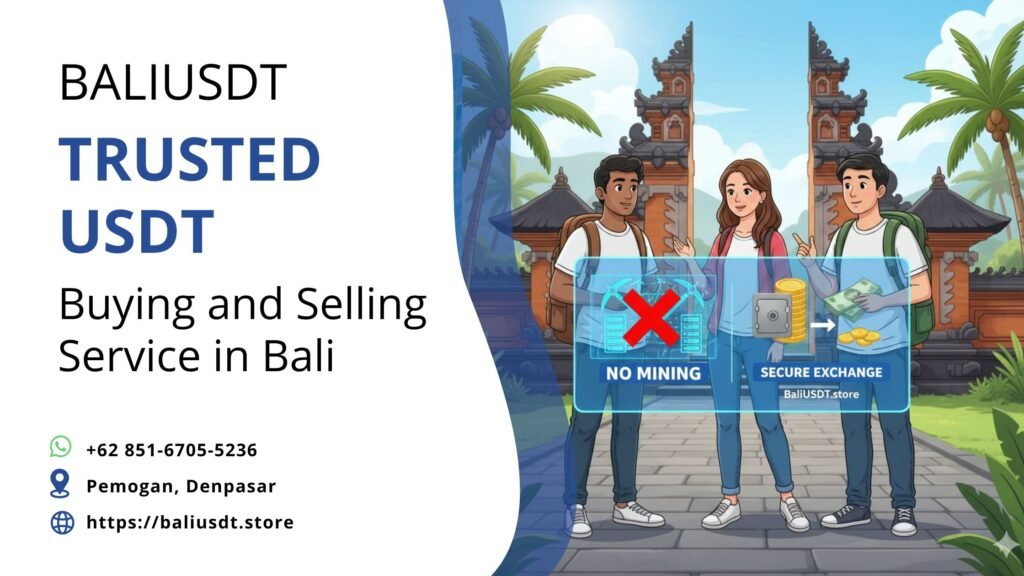
The common query among newcomers and international travelers venturing into the crypto world is how to mine USDT. If you are an expat or digital nomad setting up your life in a vibrant hub like Bali, you are likely looking for secure, efficient ways to manage your funds and generate passive income. While many cryptocurrencies like Bitcoin operate on a Proof-of-Work (PoW) system that requires resource-intensive mining, stablecoins like Tether (USDT) operate on a fundamentally different principle. Therefore, the straightforward answer to how to mine USDT is that you cannot mine it in the traditional sense. This stablecoin is centrally issued, not decentralized through a competitive mining process. Understanding this key difference is essential for using USDT safely and profitably while navigating the unique financial landscape of Indonesia.
The Critical Distinction: Mining vs. Issuance
To genuinely understand why you cannot find a viable guide on how to mine USDT, you must first grasp the core mechanisms of cryptocurrency creation. Not all digital assets are created equally, and the process of bringing them into existence varies drastically.
The Mechanism of Traditional Mining (Proof-of-Work)
The term “mining” primarily refers to the Proof-of-Work (PoW) consensus mechanism used by currencies like Bitcoin and, formerly, Ethereum.
- What Miners Do: Miners use specialized, powerful, and energy-hungry computer hardware (ASICs or GPUs) to solve complex mathematical puzzles. The first one to find the correct solution gets to add the next “block” of validated transactions to the blockchain.
- The Reward: As a reward for this computational work, miners receive newly created coins (a block reward) plus the transaction fees. This is the process that “mines” or generates new units of the cryptocurrency.
The Mechanism of USDT Issuance (Centralized Backing)
Tether (USDT) is a stablecoin, meaning its value is pegged to a fiat currency, typically the U.S. Dollar, at a 1:1 ratio. This crucial difference means it cannot, and does not, rely on mining.
- Centralized Control: New USDT is issued (or “minted”) by a centralized company, Tether Limited. It is not created by a decentralized global network of competing miners.
- The Process: New USDT tokens are created when a user deposits the equivalent amount of fiat currency (USD) with Tether Limited. Conversely, when a user redeems their USDT for USD, the tokens are “burned” (destroyed) and taken out of circulation. The supply of USDT is directly tied to the assets held in Tether Limited’s reserves.
- The Verdict: Because of this structure, there is no technical method for how to mine USDT. The tokens are created and destroyed to maintain the 1:1 peg, reflecting the reserve assets held by the issuer. Therefore, any service or app claiming to teach you how to mine USDT directly is either misleading you or referring to a completely different, often high-risk, activity.
Warning for Travelers: Avoiding “Cloud Mining” Scams
For expats and digital nomads managing finances from a distance, the allure of passive income is strong. Unfortunately, the search for how to mine USDT often leads to online platforms promoting “cloud mining” or “USDT yield mining” that are, regrettably, frequently fraudulent.
The Pitfalls of Fake Mining Platforms
Bali’s bustling digital scene makes it easy to encounter online opportunities, but caution is essential, especially with crypto investment schemes.
- The Cloud Mining Illusion: Scam platforms often promise huge daily returns on a small investment, claiming they are using your funds for efficient, hardware-less “cloud mining” of USDT. Since USDT cannot be mined, these claims are immediately false.
- The Security Risk: Engaging with these sites involves linking your crypto wallet or, worse, depositing funds into an unregulated platform. Scammers often take the initial deposit and disappear, or they use complex smart contracts to lock up funds, making withdrawal impossible.
- Safety First in Indonesia: As an international visitor, recovering lost funds from an overseas scam is extremely difficult. Always prioritize regulatory compliance and verified financial services. You should only use exchanges or platforms that have a solid, verifiable track record and are regulated in their jurisdictions. Furthermore, remember that in Indonesia, digital assets are treated as commodities, not legal tender.
How to Identify and Avoid a Scam
- Unbelievable Returns: If a passive income platform promises returns that sound too good to be true (e.g., guaranteed 1%–5% daily), it almost certainly is.
- The “Mining” Keyword: Since we established that there is no legitimate guide on how to mine USDT, treat any platform heavily relying on this terminology as suspicious.
- Lack of KYC: Legitimate financial services, especially those dealing with currency conversion and large transfers, adhere to Know Your Customer (KYC) procedures. A platform that asks for no verification is a major red flag.
Legitimate Ways to Earn with Your USDT in Bali
Since the question is not truly how to mine USDT, but rather “how to generate passive income or yield using my USDT,” let us pivot to the secure, viable strategies available to travelers and residents. These methods focus on lending and liquidity, not mining.
1. Staking and Lending on Centralized Exchanges (CEX)
This is the simplest and often safest approach for stablecoins.
- The Concept: You deposit your USDT into a CEX savings or lending account, and the exchange lends your assets to borrowers (usually traders) for margin trading.
- The Reward: The borrower pays interest, which the exchange shares with you. These yields are typically lower than DeFi but offer the protection and simplicity of a regulated exchange.
- Convenience for Expats: Managing your USDT passively through a major, well-known CEX is generally secure and allows you to access or sell your USDT quickly when you need Indonesian Rupiah (IDR).
2. Yield Farming in Decentralized Finance (DeFi)
For the more technically savvy digital nomad, DeFi offers higher potential yields but also greater risk.
- Liquidity Pools: You provide your USDT (often paired with another stablecoin like USDC) to a decentralized exchange’s liquidity pool. This helps facilitate trading on the platform.
- The Reward: You earn a portion of the trading fees generated by the pool, as well as potential governance tokens. This is often what people mistakenly refer to when they ask how to mine USDT in a passive income context.
- The Risk: DeFi involves complexities like “impermanent loss” and the risk of smart contract exploits. Only invest what you can afford to lose, and ensure you fully understand the protocol you are using.
3. Using USDT as a Bridge for Local Currency Exchange
The most practical application of USDT for travelers in Bali is not earning a yield, but using it as a fast, low-cost asset for exchange.
- The Need for Rupiah: As a traveler, you require Indonesian Rupiah for daily expenses, accommodation, and transportation. Exchanging highly volatile crypto directly can be risky.
- The USDT Advantage: USDT provides a stable 1:1 conversion rate, making it the preferred commodity to sell for IDR. Services specializing in this exchange allow you to transfer your USDT quickly (often via TRC-20) and receive local Rupiah instantly via bank transfer. This is where the utility of USDT shines for the international community.
Local Advice: Selling USDT Safely in Bali
If you have acquired USDT through legitimate means (buying, lending, or trading) and now need Rupiah for your life in Denpasar, Seminyak, or Canggu, safety is the primary concern. Since you cannot truly pursue how to mine USDT for new tokens, the focus shifts to securely liquidating your holdings.
- The OTC Market: The most common method in Bali is the Over-The-Counter (OTC) market. This involves dealing with a local, trusted broker or service.
- Verify Identity and Location: Always ensure the service provider is professional, transparent, and operates from a known, physical location if possible (like an office in Pemogan, Denpasar).
- Transaction Speed: Use the fastest blockchain network available, typically TRC-20, to minimize the time you spend waiting for the transaction to confirm.
- Legal Compliance: Ensure your chosen service handles the conversion legally, processing the USDT as a sale of a digital commodity in compliance with Indonesian law, which is crucial for international residents. For quick and secure liquidation, you might want to check the rates and process with a trusted local service, such as the one we provide, which focuses on safety and transparency.
Conclusion
The pursuit of how to mine USDT reveals a fundamental misunderstanding of stablecoins. Tether is not created through energy-intensive mining but is centrally issued by Tether Limited to maintain its U.S. Dollar peg. Consequently, rather than seeking to mine it, digital nomads and expats in Bali should focus on legitimate and secure methods to earn yield on their existing USDT holdings, such as lending or providing liquidity on established platforms. Crucially, the biggest value of USDT for the international community in Bali remains its use as a stable, fast, and efficient bridge for converting foreign funds into Indonesian Rupiah. Always prioritize security, avoid fraudulent “cloud mining” schemes, and use trusted, compliant services for your local exchanges.
Check today’s USDT selling rate via WhatsApp
📲 WhatsApp us to sell your USDT safely: +62 851-6705-5236
Pemogan, Denpasar
Read also : How Long Does It Take to Send USDT? A Traveler’s Guide to Speeds and Networks
USDT is processed as a commodity sale in Indonesia, not as a direct payment method.