Tether (USDT) is the undisputed king of stablecoins, the digital dollar used by millions to navigate the volatile crypto markets. You see its ticker everywhere, but what many users don’t realize is that “USDT” is not one single coin; it is an asset tokenized across more than a dozen different blockchain networks. Each version is functionally the same stable dollar, yet
The earliest, and arguably most important, version is USDT Omni Layer. Born from the very foundations of crypto, it paved the way for all others. But in today’s fast-paced digital world, is the pioneer still the best choice? Understanding what is the difference between USDT Omni Layer and modern iterations like ERC-20 (Ethereum) and TRC-20 (TRON) is vital for minimizing transaction costs and maximizing efficiency in your crypto operations.
From Bitcoin’s Shoulders to Ethereum’s Smart Contracts
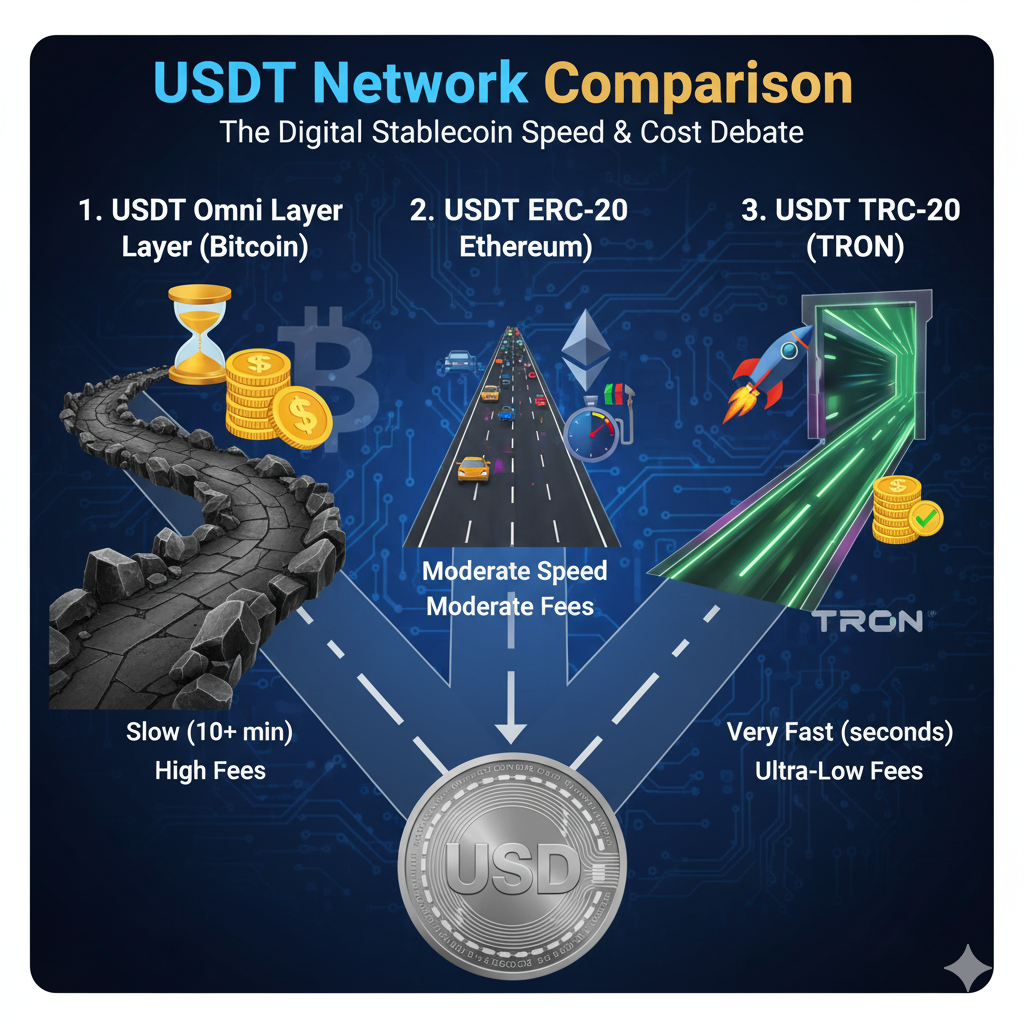
The core distinction between USDT tokens lies not in the asset itself (which is always issued by Tether Limited and pegged to the USD) but in the transport layer—the blockchain network that carries the transaction data. These networks determine the security, speed, and cost of every single transfer.
The Pioneer: USDT Omni Layer (Bitcoin)
The USDT Omni Layer is the original version, launched in 2014. It is an artifact of crypto history and the initial success of the stablecoin.
- The Technology: USDT Omni runs on the Omni Layer Protocol, which is built directly on top of the Bitcoin blockchain. It operates as a second-layer protocol, leveraging Bitcoin’s unspent transaction outputs (UTXOs) to record Tether transactions.
- The Security: Omni Layer benefits from the unrivaled security and decentralization of the Bitcoin network. Bitcoin’s colossal hash rate makes the Omni Layer extremely resilient against attacks. This is its single biggest advantage—unquestionable security.
- The Drawback (Speed & Cost): Because it is tied to the Bitcoin blockchain, transactions are slow. They are subject to Bitcoin’s block confirmation times (averaging 10 minutes, but often longer) and its increasingly high transaction fees during periods of network congestion. Omni addresses typically start with a ‘1’ or ‘3’, similar to Bitcoin addresses.
- The Role: Today, USDT Omni is rarely used for daily trading or high-frequency transfers. It primarily serves as a historical reserve and a highly secure medium for moving extremely large, high-value amounts where security is paramount, and speed is secondary.
The Market Standard: USDT ERC-20 (Ethereum)
With the rise of smart contracts and decentralized finance (DeFi), Tether shifted its focus to Ethereum, giving birth to the ERC-20 version.
- The Technology: USDT ERC-20 is a standard smart contract token on the Ethereum blockchain. It is fully compatible with Ethereum’s vast ecosystem of wallets, decentralized exchanges (DEXs), and DeFi protocols.
- The Flexibility & Adoption: ERC-20 quickly became the market standard due to Ethereum’s dominance. It allows USDT to be used seamlessly in staking, lending, and sophisticated smart contract operations. This is where most DeFi liquidity resides.
- The Drawback (Cost): Its primary weakness is the high and volatile “gas fees” on Ethereum. During periods of network congestion (high demand), the cost to send even a small amount of USDT ERC-20 can spike significantly, making small, frequent transfers uneconomical. ERC-20 addresses start with ‘0x’.
- The Role: The preferred choice for DeFi participation, institutional transfers, and users who prioritize integration with the Ethereum ecosystem despite the cost.
The Speed Demon: USDT TRC-20 (TRON)
The latest and perhaps most popular version for retail traders is the one built on TRON.
- The Technology: USDT TRC-20 is a token standard on the TRON blockchain, a network designed explicitly for high throughput and low fees.
- The Advantage (Speed & Cost): This is the version famous for its near-zero (often a few cents) transaction fees and lightning-fast confirmation times (seconds). This efficiency is due to TRON’s Delegated Proof-of-Stake (DPoS) consensus mechanism.
- The Drawback: While fast and cheap, the TRON network is sometimes viewed as less decentralized and less secure than Bitcoin or Ethereum, a trade-off that comes with its high speed. TRC-20 addresses typically start with ‘T’.
- The Role: Dominant for peer-to-peer transfers, frequent trading on exchanges, and moving money globally quickly and cheaply.
Summary of Key Differences
| Feature | USDT Omni Layer | USDT ERC-20 | USDT TRC-20 |
| Underlying Blockchain | Bitcoin | Ethereum | TRON |
| Transaction Fees | Very High (Fluctuating with BTC network congestion) | High (Fluctuating with ETH gas fees) | Very Low/Near Zero (Consistent) |
| Transaction Speed | Slow (10+ minutes) | Moderate (Minutes) | Very Fast (Seconds) |
| Security | Highest (Leverages Bitcoin’s security) | High (Leverages Ethereum’s security) | Moderate (Faster consensus, lower decentralization) |
| Primary Use | High-value secure storage / Historical reserves | DeFi, Smart Contracts, Institutional Transactions | Retail Trading, Fast P2P Transfers |
Securing Your Stablecoin Strategy
Choosing the right USDT network is not just about fees; it’s about aligning the transaction medium with your financial goal. Sending USDT Omni Layer for a quick exchange deposit will result in high fees and frustration, while using TRC-20 for a major DeFi transaction might limit your smart contract options.
As capital moves between these layers—from the high security of Omni to the low cost of TRC-20—it must be handled with precise technical knowledge. A simple error of sending USDT TRC-20 to an ERC-20 address (or vice versa) results in a permanent loss of funds. A wrong wallet address means irreversible loss.
We specialize in secure, high-volume Over-The-Counter (OTC) crypto transactions. Our service ensures that your capital is moved between USDT networks—or converted to fiat—seamlessly, securely, and with the optimal network selected for the job. We possess the deep technical expertise (E) to manage complex cross-network conversions, the established track record (A) to guarantee fund safety, and the transparent procedures (T) that earn your confidence.
Our Expertise Ensures:
- Network-Optimized Transfers: We advise on the most cost-effective and fastest route for your specific transfer needs (e.g., using TRC-20 for speed, or a secure conversion from Omni).
- Error Prevention: Our multi-layered verification process eliminates the risk of sending funds to the wrong network or address.
- Secure Fiat Conversion: Hassle-free and compliant conversion of your USDT (regardless of its layer) into fiat currency.
Don’t let network complexity or high fees erode your capital. Trust our experienced team to manage your large-volume stablecoin movements securely.
For secure, network-aware, high-volume USDT transactions, contact our specialist desk today: +6285167055236
Disclaimer: This information is for educational purposes only and does not constitute financial or investment advice. Transaction fees and network speeds are subject to change based on blockchain congestion and market conditions. Always consult a professional before making large transfers.