USDT Omni Layer vs. ERC-20: Why Your Choice of Network Affects Fees, Speed, and DeFi Access
Same Dollar, Radically Different Journey
Imagine two identical, brand-new US dollar bills. They both represent exactly one dollar, guaranteed by the same entity (Tether). However, if one dollar travels across the country via a historical, protected armored car, and the other travels via a modern, congested smart highway, the journey’s time and cost will be vastly different.
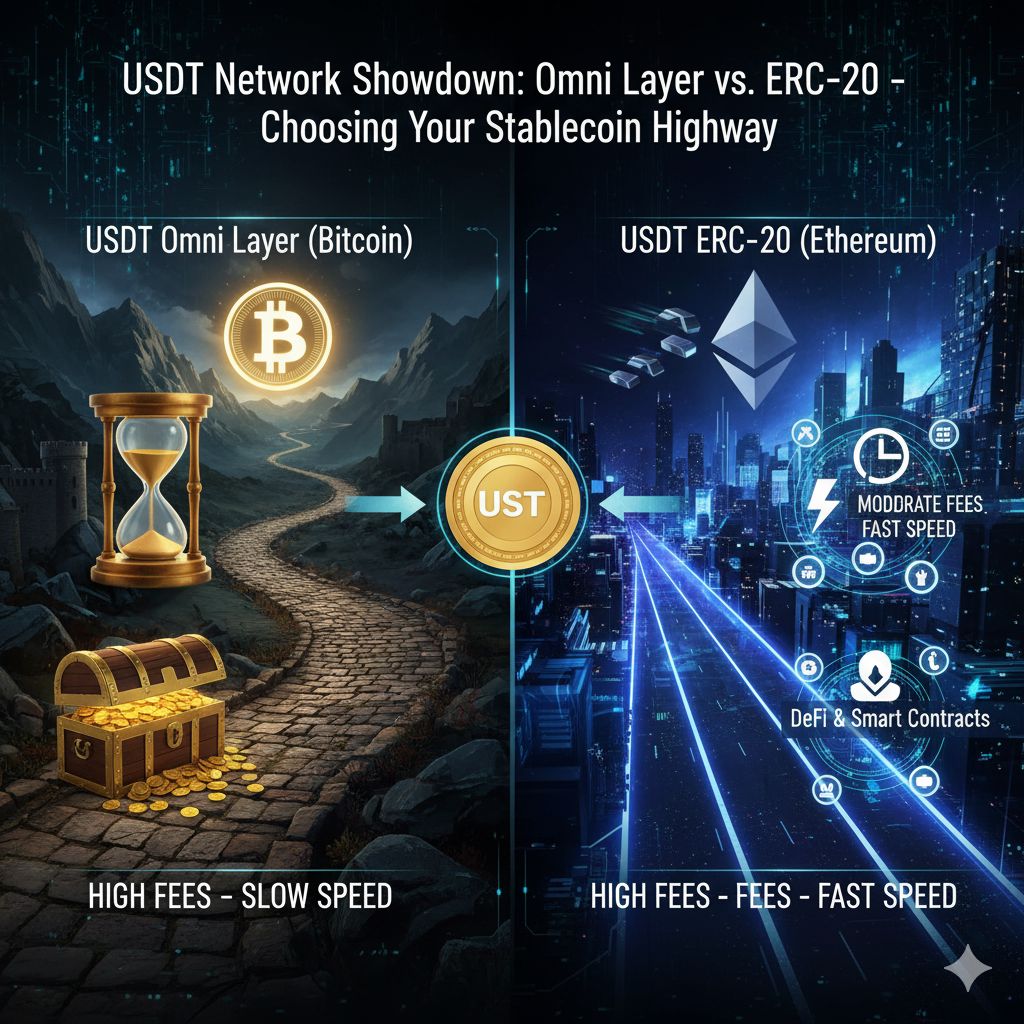
This analogy perfectly captures the core dilemma for every cryptocurrency user: the USDT Omni Layer vs. ERC-20 debate. While both are Tether tokens ($USDT), they exist on fundamentally different blockchains—Bitcoin and Ethereum, respectively. This difference is not merely cosmetic; it dictates your fees, transaction speed, and access to the wider crypto ecosystem. Understanding this technical divide is crucial for financial efficiency, security, and successfully navigating the complexities of digital asset transfers.
The Battle of Protocols – Security vs. Smart Contracts
The divergence between the two main USDT standards is a story of blockchain evolution. It moves from the foundational security of Bitcoin to the programmable potential of Ethereum. We explore the two distinct technological protocols, highlighting the trade-offs that dictate their current utility.
The Elder Statesman: USDT Omni Layer (Built on Bitcoin)
Expertise & History: USDT first saw the light of day on the Bitcoin network via the Omni Layer Protocol, formerly known as Mastercoin. This was a pioneering effort to create custom assets on top of the world’s most secure blockchain.
- Underlying Network: Bitcoin. Omni Layer is a second-layer protocol that uses the security and transaction ledger of Bitcoin. It embeds data about the movement of USDT within standard Bitcoin transactions.
- Protocol & Addresses: It uses the Omni Layer Protocol. Omni USDT addresses typically begin with a ‘1’ or ‘3’, mirroring traditional Bitcoin addresses.
- Security & Finality: This is its greatest strength. By relying on Bitcoin’s massive Proof-of-Work (PoW) security and highly decentralized miner base, Omni USDT transactions are exceptionally robust and resistant to censorship or attack.
- The Trade-Off (The Cost of Security): Because Omni transactions are fundamentally tied to the Bitcoin blockchain, they inherit its limitations:
- Speed: Block confirmation times are slow (average 10 minutes, often longer during congestion).
- Fees: Transaction fees tend to be significantly higher and fluctuate wildly with Bitcoin network congestion, making small transfers impractical and costly.
- Current Role: Today, USDT Omni Layer is largely considered a legacy network. It is primarily used by exchanges and institutional holders for extremely large-volume transfers where security is the absolute priority, and time/cost are secondary concerns.
The Modern Standard: USDT ERC-20 (Built on Ethereum)
Trust & Adoption: The shift to Ethereum was a defining moment for USDT. As the platform for smart contracts and the birthplace of DeFi, Ethereum offered the flexibility that Omni lacked.
- Underlying Network: Ethereum. ERC-20 USDT is a standard token created by a smart contract on the Ethereum blockchain.
- Protocol & Addresses: It uses the standardized ERC-20 Token Standard. ERC-20 addresses universally start with ‘0x’ and are compatible with all Ethereum wallets and tools.
- Functionality & Ecosystem: This is its clear advantage. As an ERC-20 token, it is instantly compatible with thousands of decentralized applications (dApps), decentralized exchanges (DEXs), lending platforms, and other DeFi protocols. It is the dominant choice for interacting with the Ethereum ecosystem.
- The Trade-Off (Congestion & Gas): While superior in speed and utility compared to Omni, ERC-20 has its own drawback:
- Fees (Gas): Transactions require “Gas,” paid in ETH, which can be very high and unpredictable during peak network activity (congestion).
- Speed: Faster than Omni (seconds to minutes), but still subject to network congestion.
- Current Role: USDT ERC-20 is the default choice for the majority of modern crypto activity, especially involving DeFi, smart contracts, and most centralized exchange deposits/withdrawals due to its vast integration.
Summary of Key Differences: Omni vs. ERC-20
| Feature | USDT Omni Layer | USDT ERC-20 |
| Underlying Network | Bitcoin | Ethereum |
| Protocol Type | Second-layer Protocol (Omni Layer) | Smart Contract Token Standard (ERC-20) |
| Address Format | Starts with ‘1’ or ‘3’ (Bitcoin-style) | Starts with ‘0x’ (Ethereum-style) |
| Transaction Fees | Very High (Fluctuating with BTC congestion) | High/Variable (Fluctuating with ETH gas fees) |
| Transaction Speed | Slow (10+ minutes) | Moderate (Seconds to minutes) |
| Primary Utility | Maximum Security & Storage (Legacy) | DeFi, DApp Integration, Smart Contracts |
Navigate the Network Maze with Expertise
The crucial takeaway from the USDT Omni Layer vs. ERC-20 comparison is that choosing the wrong network can cost you significant time and money. For high-frequency traders, paying Omni or high ERC-20 gas fees drastically reduces profits. For institutional investors, mistakenly sending large capital to the wrong network protocol could result in irreversible loss.
We offer specialized Over-The-Counter (OTC) services designed to help you navigate these complex network choices. Our team provides the deep technical Expertise required to:
- Optimize Transfers: Select the most cost-effective and fastest USDT network for your specific transaction goal (e.g., converting capital from a secure Omni address to a high-speed TRC-20 address, or to fiat).
- Ensure Security: Our rigorous multi-point verification process guarantees that your funds, regardless of the network, are delivered to the correct address format, mitigating the risk of human error—the number one cause of fund loss in cross-network transfers.
- Provide High-Volume Liquidity: We hold a proven track record and Authority in handling large transactions, offering guaranteed liquidity for converting your USDT (Omni, ERC-20, or other layers) into fiat or other assets seamlessly and compliantly. We build Trust through transparent, documented processes.
Don’t let the technical differences between USDT networks become a liability. Leverage our expertise for secure, efficient, and cost-optimized stablecoin management.
For secure, high-volume, and network-optimized USDT solutions, contact our specialist desk today: +6285167055236
Disclaimer: This analysis is for informational purposes only. Transaction fees and speeds are dynamic. Always confirm the supported network (Omni, ERC-20, TRC-20, etc.) with your receiving platform before initiating any transfer to avoid permanent loss of funds.