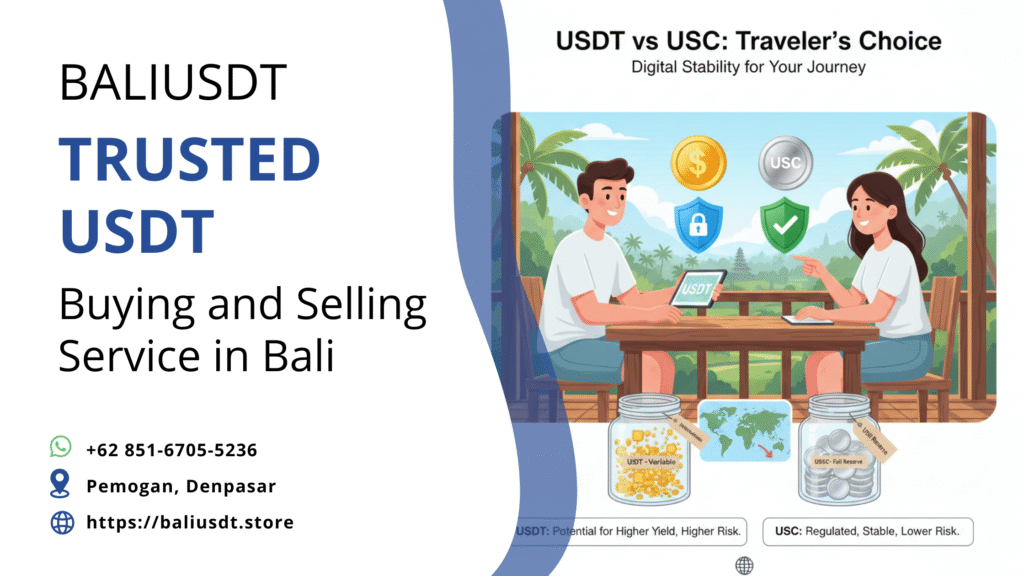
The essential financial safety question for the savvy international traveler, digital nomad, or long-term expat is which is safer USDT or USDC? Both Tether (USDT) and USD Coin (USDC) are stablecoins. They are designed to maintain a consistent 1:1 value peg with the US Dollar, making them indispensable for managing cross-border finances. However, they show significant differences in governance, regulatory compliance, and reserve transparency. While USDC earns praise for its commitment to regulation and monthly audits, USDT holds the advantage of overwhelming market liquidity and broader exchange adoption worldwide. Travelers must understand these key distinctions to determine which stablecoin best meets their personal risk tolerance and practical needs when moving funds in and out of Indonesia.
The Regulatory and Transparency Debate
The core difference that drives the safety comparison between the two leading stablecoins lies in their commitment to audits and regulatory adherence. This determines which is the better answer to which is safer USDT or USDC.
USDC: The Champion of Transparency
USD Coin, issued by Circle, explicitly positions itself as the compliant, transparent stablecoin choice.
- Regular Attestations: USDC provides monthly attestation reports from reputable accounting firms. These reports publicly verify that USDC’s reserves—primarily cash and U.S. Treasury bonds—match the coins in circulation.
- U.S. Regulation Focus: Circle operates under stringent U.S. financial regulations. This commitment to compliance makes USDC the preferred stablecoin for institutional investors and users who prioritize legal clarity.
- Institutional Trust: Consequently, USDC’s regulatory-first approach offers a higher degree of perceived safety. This appeals directly to users who need institutional-grade security for their assets.
In this crucial area of reserve transparency and regulatory oversight, USDC generally holds the stronger position.
USDT: The Dominance of Liquidity and Adoption
Despite concerns over transparency, the practical answer to which is safer USDT or USDC for a traveler often favors USDT due to its utility. USDT remains the undisputed market leader in market capitalization and daily trading volume.
Liquidity Is King for Travelers
For an individual who needs to convert their digital assets into local currency quickly and efficiently, liquidity proves paramount.
- Wider Exchange Acceptance: USDT is listed on virtually every centralized and decentralized exchange globally. This vast market penetration ensures you can almost always find a trading pair for your USDT, regardless of your location.
- Deeper Liquidity Pools: The enormous trading volume of USDT means liquidity is deep. This results in less “slippage”—the difference between the expected price and the execution price—which benefits users executing large transfers or sales.
- Cross-Chain Versatility: Furthermore, issuers offer USDT natively on high-volume, low-cost chains like Tron (TRC-20). TRC-20 remains the dominant network for rapid, low-fee stablecoin transfers throughout Southeast Asia. Therefore, when evaluating which is safer USDT or USDC based on immediate accessibility in Asian markets, USDT holds an advantage.
This widespread adoption and deep liquidity make USDT the practical choice for active travelers who need reliable, fast off-ramps.
Network Utility: Fees and Compatibility in Southeast Asia
For digital nomads operating on the move, the cost and speed of transferring funds become critical operational factors. Here, the stablecoin’s technical infrastructure significantly influences which is safer USDT or USDC from a convenience perspective.
TRC-20 vs. ERC-20: The Cost Difference
The network choice dictates both the transaction speed and cost, directly impacting your travel budget.
- USDT on TRC-20: USDT’s prominence on the Tron (TRC-20) network means transfers cost mere cents and clear in seconds. This provides the gold standard for cost-efficient transfers, and local conversion services in Indonesia widely support it.
- USDC’s Focus: USDC concentrates primarily on the Ethereum (ERC-20) network, where gas fees can prove expensive. While USDC is also available on cheaper chains like Solana and Polygon, those networks may lack the ubiquitous support of TRC-20 in certain local Indonesian off-ramps.
While both stablecoins are fundamentally secure, the operational safety and budget security of using TRC-20 USDT for transfers often make it the more sensible choice for a traveler in this region. You must understand that which is safer USDT or USDC is not just about the coin itself, but also the most efficient network to use.
De-Peg Risk and Historical Events
No stablecoin is entirely risk-free. Both USDT and USDC have experienced brief de-pegging events, which shows the question of which is safer USDT or USDC also relies on historical resilience during market crises.
Analyzing Stability Under Duress
Market events have tested both stablecoins, giving us valuable insight into their respective stabilizing mechanisms.
- USDC’s De-peg: In March 2023, USDC briefly de-pegged, dropping to around $0.87. This happened when Circle disclosed that $3.3 billion of its reserves were held at the failed Silicon Valley Bank (SVB). Thanks to its transparent backing structure and quick action by U.S. regulators, the peg was restored rapidly.
- USDT’s Resilience: USDT has faced scrutiny regarding its reserve composition, yet it maintained its peg with greater consistency during major crypto market crashes. This battle-tested longevity, dating back to 2014, gives many traders confidence in its ability to withstand extreme market pressure.
In the end, both have proven mechanisms for restoring the peg. USDC’s issues stemmed from regulated banking exposure, while USDT’s issues have historically focused on reserve transparency.
Practical Recommendation for Travelers in Bali
Considering all factors—security, liquidity, and local utility—the best choice depends on the traveler’s primary use case.
Choosing the Right Stablecoin for Indonesian Expediency
For those needing reliable, quick, and low-cost conversion into Indonesian Rupiah (IDR), practicality often favors USDT.
- For Long-Term Storage (USDC): If you are an institutional investor or hold very large amounts for extended periods, and regulatory compliance is your absolute highest priority, you may prefer USDC.
- For Active Travel Funds (USDT): If you require the highest liquidity, the lowest transaction fees (via TRC-20), and the broadest exchange acceptance for rapid fund movement, USDT often proves the more efficient operational choice. Which is safer USDT or USDC becomes a comparison between institutional transparency and global trading dominance.
Regardless of your choice, the final step in Indonesia remains the same: the asset must be securely and compliantly converted into IDR. Always avoid high-risk, informal P2P swaps. Use a verified service for the commodity sale to ensure security and adhere to local law. You can visit BaliUSDT.store for information on secure conversion services.
Conclusion
The answer to which is safer USDT or USDC is complex: USDC offers superior regulatory transparency and reserve auditing, which appeals to institutions. Conversely, USDT provides vastly superior market liquidity and broader adoption, particularly on the low-cost TRC-20 network preferred by travelers in Southeast Asia. For the everyday digital nomad in Bali, the convenience and efficiency of USDT often outweigh the regulatory premium of USDC. Therefore, travelers should choose the stablecoin that aligns with their risk tolerance, but they must manage it securely and compliantly sell it as a commodity to obtain Indonesian Rupiah.
Get guidance for selling USDT legally in Indonesia
📲 Whatsapp us to sell your USDT safely: +62 851-6705-5236
Visit our office in Bali for secure USDT selling: Pemogan, Denpasar
USDT is processed as a commodity sale in Indonesia, not as a direct payment method.
Read also: Is Ledger Safe for USDT? What Travelers Need to Know