For international travelers and digital nomads operating their finances from global hotspots like Bali, stablecoins are indispensable tools for maintaining value and liquidity. As the market evolves, many variations of the USD-pegged asset have emerged, leading to a crucial question for informed users: What is the difference between TUSD and USDT? Both TrueUSD (TUSD) and Tether (USDT) aim to keep their value stable at $\$1.00$, offering a digital alternative to fiat currency. However, their methods of achieving this stability, the transparency of their backing reserves, and their overall market dominance present key differences that directly influence which asset a traveler might choose for secure financial management and conversion while residing in Indonesia.
Reserve Structure and Trust: Auditing vs. Attestation
The most fundamental area when analyzing What is the difference between TUSD and USDT? lies in how each coin proves its backing and assures users of its stability.
TUSD (TrueUSD): Real-Time Verification and Escrow Accounts
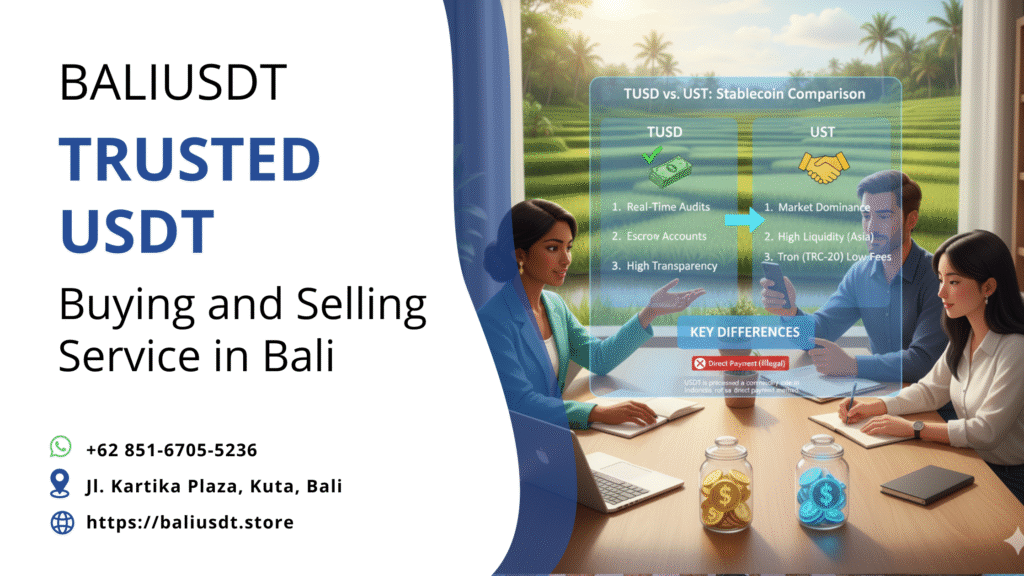
TrueUSD (TUSD) distinguishes itself by emphasizing regulatory compliance and real-time transparency. TUSD often uses legally binding escrow accounts to hold its fiat reserves, meaning the money is held by independent third-party trust companies rather than the issuer itself. Crucially, TUSD aims to provide real-time, verifiable attestation of its reserves. This means that users can, in theory, verify the amount of US Dollars backing the TUSD supply at any given moment through automated, often third-party, reporting systems. For travelers and expats prioritizing regulatory clarity and verified backing, TUSD’s structure often provides a higher degree of confidence.
USDT (Tether): Market Dominance and Reserve Composition
USDT, issued by Tether Limited, holds the title of the largest stablecoin by a significant margin. While Tether now provides regular reserve attestation reports, the composition of these reserves has historically been broader, including cash equivalents, commercial paper, and other assets, rather than strictly 100% cash in regulated banks. While this structure has supported USDT’s massive scale and liquidity, it presents a different risk profile compared to TUSD’s more strictly managed reserves. When considering What is the difference between TUSD and USDT? from a risk perspective, Tether’s liquidity is its strength, while reserve transparency has historically been TUSD’s.
Market Adoption and Practical Liquidity in Southeast Asia
For a digital nomad in Bali, the technical differences often take a back seat to practical considerations: which coin is easier and cheaper to use and convert?
USDT’s Unmatched Liquidity and Market Penetration
USDT dominates the global trading volume and is ubiquitously listed on almost every exchange and DeFi platform worldwide. In regions like Southeast Asia, and specifically Bali, USDT’s liquidity and market acceptance are significantly higher than TUSD. Local OTC services and regional exchanges are highly optimized for USDT transactions. Consequently, converting large amounts of USDT to Indonesian Rupiah (IDR) is often faster, with potentially tighter spreads (better rates), because of this overwhelming liquidity. This practical edge is often the decisive factor for travelers when deciding which asset to hold.
TUSD’s Trading Volume and Local Access
While TUSD is a well-respected and transparent stablecoin, its trading volume and market cap are substantially smaller than those of USDT. This lower volume can translate into slightly less favorable exchange rates or difficulty liquidating very large amounts quickly, especially when dealing with smaller, local OTC services. Therefore, travelers must confirm that the local service provider, such as our partners found via BaliUSDT.store, actively supports TUSD before attempting a conversion. This difference in market presence is a key answer to What is the difference between TUSD and USDT? in a real-world, localized context like Bali.
Transaction Networks and Cost Efficiency for Travelers
The cost and speed of moving these assets are critical for expats managing ongoing expenses or remittances from Bali.
- USDT on Tron (TRC-20): USDT’s massive adoption on the Tron network (TRC-20) means that moving it is usually extremely fast (minutes) and very cheap, costing fractions of a dollar per transaction. This network efficiency makes USDT highly popular for frequent, cross-border value transfer, as it saves significantly on cumulative fees over time.
- TUSD Network Options: TUSD is also multi-chain (Ethereum, BNB Chain, etc.), but its movement on cheaper chains is less universally adopted than USDT on Tron. If a TUSD holder chooses to use the older Ethereum network (ERC-20), they often face higher ‘gas’ fees and potentially slower confirmation times, which can add up quickly for frequent travelers.
Therefore, from the perspective of pure cost and convenience, the massive infrastructure supporting USDT on low-fee networks gives it a considerable edge, influencing the choice of many digital nomads who constantly weigh What is the difference between TUSD and USDT? based on operational expenses.
Safety, Regulation, and Local Compliance in Indonesia
Regardless of which stablecoin you choose, safety in Bali involves adherence to local legal frameworks.
Treating Both as Commodities, Not Currency
Indonesian law treats all cryptocurrencies, including TUSD and USDT, as commodities for trading purposes. It is illegal to use them for direct payment of goods and services. The risk of legal penalties, including deportation, is the greatest safety hazard for tourists attempting to use any stablecoin for local payments. Therefore, whether you hold TUSD or USDT, the compliant method is always to convert it to Rupiah (IDR) first.
Secure Conversion Point is Essential
When you need to liquidate either TUSD or USDT for IDR cash, the security of the transaction environment is paramount. Always use professional, verified OTC services that operate from a secure, brick-and-mortar office. For instance, our reliable facility located at JL. KARTIKA PLAZA, KUTA, KEC. KUTA, KAB. BADUNG, BALI 80361, provides a monitored, safe space for these necessary financial exchanges. This practice minimizes the physical risks associated with carrying large amounts of cash or meeting unverified parties.
Concluding the Stablecoin Comparison for Expats
The choice between TUSD and USDT often boils down to a trade-off between verifiable transparency and unparalleled liquidity. TUSD offers users greater confidence in its audited reserves and independent escrow, making it appealing for users prioritizing regulatory safety and reserve clarity. However, USDT provides vastly superior market liquidity, cheaper transaction costs via TRC-20, and broader acceptance among local service providers. For the typical Bali resident whose primary need is fast, cheap, and reliable conversion into IDR for daily spending, USDT’s market dominance makes it a highly convenient option, provided they are comfortable with the issuer’s transparency model.
Conclusion
In summary, the key answer to What is the difference between TUSD and USDT? lies in their operational transparency and market reach. TUSD excels in verifiable reserve backing and regulatory adherence, appealing to cautious investors. Conversely, USDT dominates in terms of liquidity, low transaction costs, and global adoption, offering superior convenience for the frequent cross-border financial needs of digital nomads in Bali. Whichever stablecoin you choose, always remember to respect Indonesian currency laws by converting the asset to IDR through a secure and professional service before making any local payments.
Ready to convert your digital assets (USDT or TUSD) into local spending power safely and compliantly?
📲 WhatsApp us to sell your USDT safely: +62 851-6705-5236
Check today’s USDT selling rate via WhatsApp
USDT is processed as a commodity sale in Indonesia, not as a direct payment method.
Read More: What is the Difference Between USDT and USDC? Bali Guide