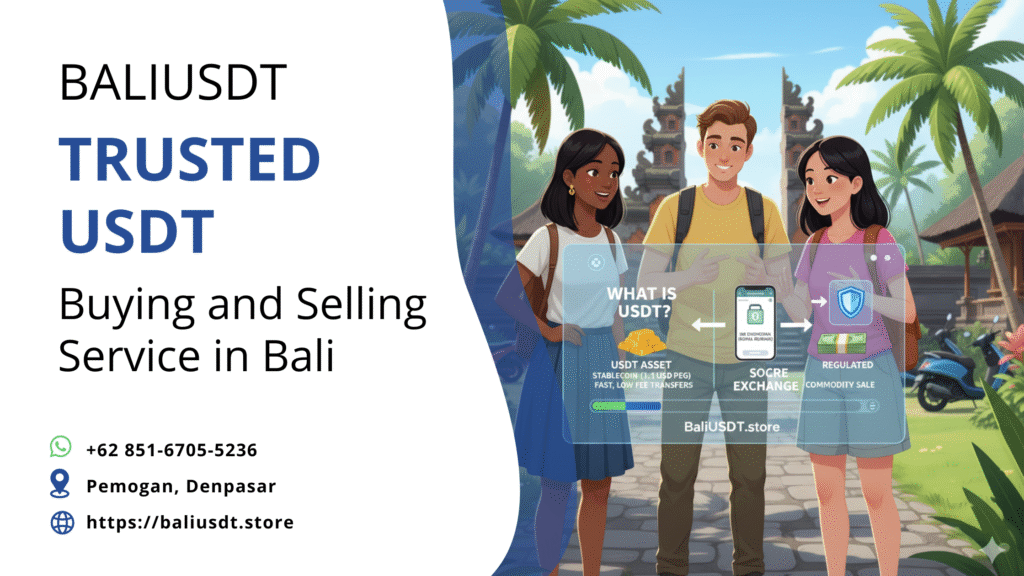
When managing finances on the move in a dynamic place like Bali, the question of what is USDT in crypto quickly becomes a matter of practicality and convenience. For international travelers, digital nomads, and long-term expats, USDT—or Tether—is arguably the most crucial digital asset after Bitcoin and Ethereum. Unlike those highly volatile assets, USDT is a ‘stablecoin,’ meaning its value is designed to remain constant, pegged 1:1 to the U.S. Dollar. This unique feature transforms it from a speculative investment into a powerful financial tool, essentially acting as a digital dollar that can be moved across borders and converted into Indonesian Rupiah (IDR) faster and cheaper than traditional banking methods. Understanding this digital currency is the key to unlocking seamless, modern financial management while you enjoy your life abroad.
The Core Concept: USDT as a Stablecoin
To fully grasp what is USDT in crypto, we must first define the concept of a stablecoin. Simply put, a stablecoin is a cryptocurrency engineered to minimize price volatility, in stark contrast to the dramatic price swings typical of traditional cryptocurrencies.
The 1:1 USD Peg
USDT’s stability is its primary feature. The issuer, Tether Limited, claims that every USDT token in circulation is backed by a corresponding equivalent value of reserves, which traditionally include U.S. Dollars, cash equivalents, and other assets.
- How it Works: The intent is that 1 USDT should always be redeemable for $1 USD. This peg eliminates the headache of market fluctuation that would otherwise make budgeting impossible for travelers.
- The Travel Advantage: Consequently, when you hold $1,000 worth of Bitcoin, its value might drop to $800 overnight. However, $1,000 worth of USDT should reliably remain near $1,000, offering predictability for managing rent, travel costs, and daily expenses in Bali.
The Centralization Trade-off
It is important to note that USDT is a centralized stablecoin. This means its issuance and reserves are managed by a single company, Tether Limited, rather than through a decentralized network like Bitcoin. Therefore, your trust is placed in the company’s ability to maintain the reserve backing, a factor that has historically been the subject of regulatory scrutiny but has, so far, maintained its dominance in the global stablecoin market.
USDT’s Essential Utility for Cross-Border Life
For expats and digital nomads, what is USDT in crypto is best answered by its practical application in cross-border finance. Its benefits directly address the biggest pain points of international money management: speed, cost, and access.
1. Speed and Efficiency: Bypassing Banking Delays
Traditional international wire transfers (SWIFT) are notoriously slow, often taking 3 to 5 business days, and they do not operate on weekends or holidays—a significant inconvenience when you need cash immediately to pay for your visa extension or a local service provider in Denpasar.
- Instant Settlement: USDT transfers occur on the blockchain, which operates 24/7/365. Depending on the network chosen (e.g., TRC-20, a popular choice), transactions can settle in seconds to a few minutes.
- 24/7 Access: This round-the-clock availability means you can move funds at any time, regardless of time zones or Indonesian banking hours, ensuring you always have fast access to your capital.
2. Cost Savings: Defeating High Fees
Traditional banks and remittance services levy substantial fees for international transfers, often comprising a wire fee, an intermediary bank fee, and a hidden foreign exchange markup.
- Low Transaction Costs: A typical USDT transfer fee is negligible, often costing mere cents, especially on efficient networks like Tron (TRC-20). This significantly reduces the overall cost of moving funds from your overseas bank account to your wallet in Indonesia.
3. Hedging Against Local Currency Volatility
While the Indonesian Rupiah (IDR) is generally stable, local currencies in emerging markets can sometimes experience unexpected fluctuations.
- Store of Value: Digital nomads can choose to hold the bulk of their savings or income in USDT. This preserves the value of their funds in U.S. Dollars, offering a shield against potential local currency devaluation until they are ready to convert it into IDR for spending.
Navigating the Technology: USDT Networks
Understanding what is USDT in crypto also involves recognizing that Tether operates on multiple different blockchain networks. This is a crucial point for safety and efficiency, particularly when conducting local exchanges.
The Multi-Chain Reality
USDT is not confined to one chain. It exists as tokens on several major blockchains, and the network you choose dictates the speed and cost of your transaction.
- TRC-20 (Tron Network): Currently the most favored network for travelers in Southeast Asia. It offers near-instant confirmation and virtually zero transaction fees, making it perfect for quick, regular exchanges into IDR.
- ERC-20 (Ethereum Network): The original and highly secure network for USDT. However, transactions are slower (minutes to an hour) and gas fees can be prohibitively expensive during peak times. Generally, avoid ERC-20 for small, quick cash-outs.
- Other Networks: USDT is also available on networks like BNB Smart Chain (BEP-20) and Solana, which also offer fast, low-cost options.
Local Tip: When dealing with a local USDT exchange service in Bali, always confirm which network they support. Sending USDT on the wrong network (e.g., sending ERC-20 tokens to a TRC-20 address) will result in a permanent loss of funds, regardless of what is USDT in crypto.
🇮🇩 Local Context: Safety and Conversion in Bali
For a foreign tourist, expat, or digital nomad, the main use of USDT is the seamless conversion into Indonesian Rupiah (IDR). This process, known as an ‘off-ramp,’ is where safety and convenience are most critical.
The Off-Ramp Experience
Since cryptocurrencies are regulated as commodities in Indonesia, you cannot legally pay for coffee or accommodation directly with USDT. Instead, you sell your USDT commodity for IDR.
- The Need for a Trusted Partner: This requires dealing with a reliable, local Over-The-Counter (OTC) service. A trusted service will take your USDT and, upon blockchain confirmation, instantly transfer the equivalent IDR to your local bank account or provide cash. Choosing a secure service is paramount to avoid fraud.
- Legal Compliance in Indonesia: Using a legitimate service ensures that the transaction is processed as a commodity sale, adhering to Indonesia’s financial regulations. This is a critical legal note for any foreign resident.
For securing the best rates and guaranteeing a compliant transaction when you need Rupiah for your life in Bali, reaching out to a dedicated local specialist is highly recommended. To get started quickly and safely, you can visit our service page at BaliUSDT.store. We are experts in answering the financial needs of the international community by focusing on the safe and fast conversion of digital assets.
Conclusion
The question of what is USDT in crypto is answered by its role as the digital dollar, offering unparalleled stability, speed, and cost-efficiency for cross-border transactions. For travelers, expats, and digital nomads in Bali, USDT is not just a cryptocurrency; it is an essential financial tool that allows you to manage your funds globally with the stability of the USD and the instant speed of the blockchain, especially on the low-fee TRC-20 network. By understanding its function as a stablecoin and utilizing reliable local services for conversion, you can simplify your financial logistics, ensuring your focus remains on the incredible experiences Bali has to offer.
Visit our office in Bali for secure USDT selling
📲 WhatsApp us to sell your USDT safely: +62 851-6705-5236
Pemogan, Denpasar
Read also : How to Convert USDT to AUD: A Safe Guide for Australian Travelers
USDT is processed as a commodity sale in Indonesia, not as a direct payment method.