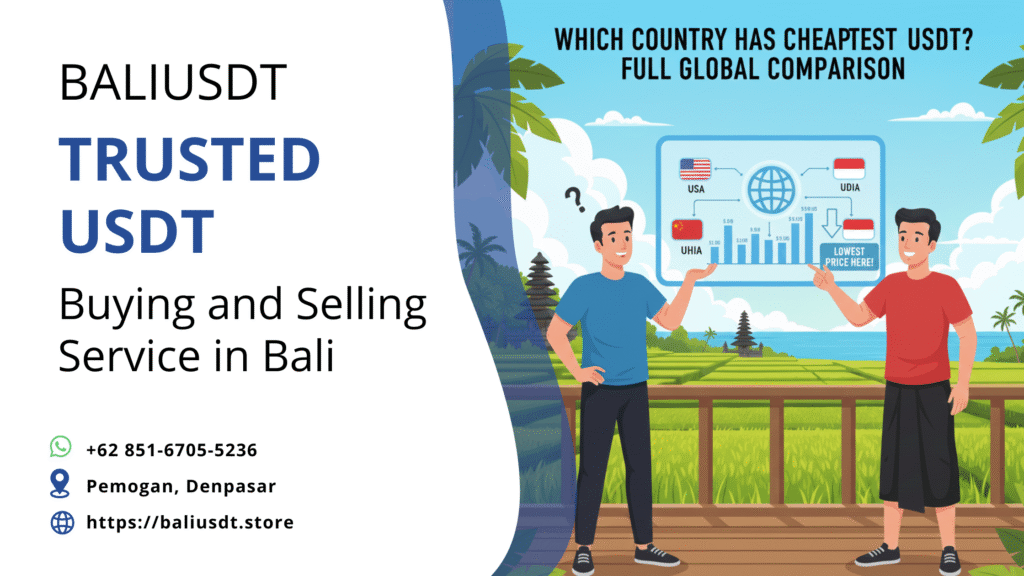
The question, which country has cheapest USDT, stems from a common misconception that stablecoins behave like regular currencies with fluctuating exchange rates based on geography. Tether (USDT) is a fiat-backed stablecoin, pegged 1:1 to the US Dollar. Therefore, its price should ideally be the same everywhere: $1 USD. However, while the nominal price remains constant, the effective cost—what you pay to acquire or sell it—varies significantly by country, determined by local regulations, exchange liquidity, and banking fees. For international travelers and digital nomads, minimizing these peripheral costs is the real key to finding the “cheapest” USDT.
The USDT Peg: A Universal Price Standard
First, we must establish why the price of USDT itself does not change based on which country you are in.
The Role of Arbitrage
USDT’s value is maintained by a powerful, global mechanism called arbitrage.
- Constant Correction: If USDT were to trade for $1.01 USD in one market and $0.99 USD in another, arbitrageurs would instantly buy the cheaper USDT and sell the more expensive USDT. This high-volume activity quickly corrects the price back to $1.00 USD across all major centralized exchanges (CEXs) worldwide.
- Tether’s Reserve: The issuer, Tether Limited, also offers direct redemption for large amounts, ensuring the 1:1 peg remains enforceable. This structural enforcement explains why you will not find a country where the base price of USDT is consistently $0.90 or $1.10.
Therefore, the answer to which country has cheapest USDT is not about the face value of the coin, but the total cost of the transaction process.
Fees and Fiat On-Ramps: The Real Cost Factors
The actual cost of USDT depends almost entirely on the fees you pay to convert your local fiat currency (like EUR, AUD, or IDR) into the stablecoin. These costs are highly dependent on the country’s banking system and regulatory environment.
1. Fiat Deposit Fees (The On-Ramp)
This is the most significant variable cost. Countries with advanced and free banking infrastructure offer the “cheapest” entry point.
- European Union (EU) and UK: Countries within the Single Euro Payments Area (SEPA) benefit immensely. Many major global exchanges offer free deposits via SEPA transfer (EUR). Similarly, the UK often offers free deposits via Faster Payments (GBP). This access to free fiat deposits makes the USDT acquisition process extremely low-cost in these regions.
- North America: US residents often benefit from free ACH transfers. However, international wire transfers can be expensive.
- Developing Markets: In countries with less accessible banking or stricter currency controls, the options are often limited to credit card purchases (incurring high fees, 3-5%) or less efficient local bank transfers, dramatically increasing the cost of USDT.
For a traveler, starting with free or near-free fiat deposits from your home country’s bank is the best way to determine which country has cheapest USDT for your initial funds.
2. Trading Fees
While most major exchanges have competitive and often zero-fee spot trading pairs (like BTC/USDT), the underlying fees for acquiring a volatile asset and then selling it for USDT can vary slightly based on the exchange’s fee tier. Some exchanges also offer discounts for holding their native tokens (like BNB).
Regional Price Discrepancies: The P2P Effect
While major CEXs maintain the $1.00 USD peg, price deviations do appear in local markets, especially in Peer-to-Peer (P2P) trading platforms.
USDT Premium and Discount
P2P markets allow individuals to trade directly. Prices here are driven by local factors, not global arbitrage:
- High Demand/Low Supply (Premium): In countries facing high inflation (e.g., Turkey or Argentina) or strict capital controls, the local demand for a USD-pegged stablecoin can be immense. Buyers will often pay a premium, meaning USDT costs more than $1 USD in local currency terms.
- Regulatory Risk (Discount): If a country bans crypto or issues threats against exchanges, a sudden sell-off can briefly push USDT below the $1.00 USD peg as users rush to sell.
For travelers, these regional premiums or discounts are usually irrelevant for large-scale financial management. You should focus on avoiding fees, rather than chasing tiny, unstable price differences on P2P markets.
The Traveler’s Strategy: Minimizing Fees in Southeast Asia
For a traveler in a place like Bali, Indonesia, the question shifts from which country has cheapest USDT for acquisition to how do I sell USDT most effectively?
The Importance of the TRC-20 Network
After acquiring your USDT with low fees in your home country (e.g., via free SEPA transfer), the most critical step for minimizing cost while traveling is using the correct blockchain network.
- Choose TRC-20: Always transfer your USDT using the TRC-20 (Tron) network. Transaction fees are negligible (often less than $1 USD). Using the ERC-20 (Ethereum) network means high and volatile “Gas Fees,” effectively making your USDT dramatically more expensive to use.
- Local Off-Ramp Efficiency: Once your low-fee USDT is in your private wallet, you need a secure local off-ramp to convert it to Indonesian Rupiah (IDR). Reputable local services offer competitive rates based on the real-time USD/IDR exchange rate.
Safety and Compliance in Indonesia
Foreign tourists must prioritize safety. Converting digital assets to cash should occur in a secure, professional environment.
- Use Verified OTC: Seek out verified Over-The-Counter (OTC) desks instead of risky street changers or unverified P2P contacts. An established office, such as our location in Pemogan, Denpasar, provides security and ensures compliance with local transaction guidelines.
- Get Guidance: When selling USDT, use resources that guarantee transparency. You can check competitive local rates and get secure selling assistance at BaliUSDT.store. This ensures you receive the maximum IDR value for your digital dollar.
Conclusion
The price of USDT is tethered to the US Dollar globally, making the idea of which country has cheapest USDT a misconception. The actual cost is defined by the fees charged to convert your local fiat currency into USDT (the on-ramp) or to convert USDT into local cash (the off-ramp). Countries with free bank transfer systems (like the EU/UK with SEPA) offer the cheapest acquisition. For travelers in places like Indonesia, maintaining the lowest effective cost means two things: always using the low-fee TRC-20 network for transfers and utilizing secure, compliant local OTC services for conversion into IDR cash. By focusing on fee mitigation and safety, you maximize your financial efficiency abroad.
Get guidance for selling USDT legally in Indonesia
📲 Whatsapp us to sell your USDT safely: +62 851-6705-5236
Visit our office in Bali for secure USDT selling: Pemogan, Denpasar
USDT is processed as a commodity sale in Indonesia, not as a direct payment method.
Read also: How Does Tether USDT Work? Smart Choice for Digital Nomads