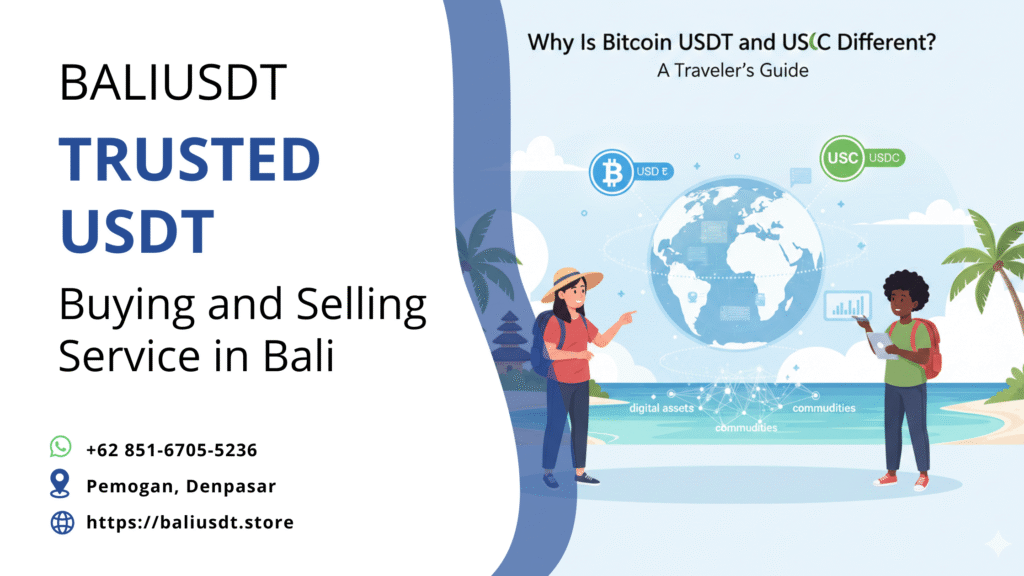
The question, why is Bitcoin USDT and USDC different, is fundamental for any international traveler or digital nomad entering the crypto world. Although all three are digital assets, they serve fundamentally separate economic and practical purposes. Bitcoin (BTC) is a highly volatile, decentralized asset primarily used as a long-term store of value—often referred to as “digital gold.” In contrast, USDT (Tether) and USDC (USD Coin) are stablecoins. Stablecoins are designed to maintain a 1:1 value peg with the US Dollar, making them reliable mediums of exchange. Understanding these core differences is crucial for safely managing your funds while traveling in locations like Bali, where stablecoins are essential for daily financial operations.
Difference 1: Volatility and Purpose
The most significant distinction that answers why is Bitcoin USDT and USDC different lies in their intended use and price behavior.
Volatility: Speculation vs. Stability
Bitcoin and the two stablecoins occupy opposite ends of the price stability spectrum.
- Bitcoin (BTC): Bitcoin’s price floats freely, driven purely by market supply, demand, and investor speculation. This makes it highly volatile. Bitcoin’s volatility is what attracts investors seeking potentially massive returns, but it makes it unsuitable for daily budgeting. You cannot budget for an espresso when the cost in BTC changes minute by minute.
- USDT and USDC (Stablecoins): Both USDT and USDC are designed for stability. They aim to keep a consistent $1.00 USD value. This stability makes them perfect for quick payments, remittances, and as a safe haven during market volatility. As a traveler, stability is paramount for accurate budgeting and swift currency conversion into Indonesian Rupiah (IDR).
Ultimately, Bitcoin is a high-risk investment asset, whereas stablecoins are practical financial tools.
Difference 2: Decentralization and Control
The underlying technology and management structure also clearly explain why is Bitcoin USDT and USDC different in terms of trust and governance.
Trust Model: Centralized vs. Trustless
The level of centralization is the second key differentiator among these three digital assets.
- Bitcoin (BTC): Bitcoin is completely decentralized and trustless. No single company or authority controls it. The network operates on a Proof-of-Work (PoW) consensus mechanism, and its rules are immutable. This makes it censorship-resistant and appealing as a sovereign store of value.
- USDT and USDC (Stablecoins): Both stablecoins are fundamentally centralized. They are issued and managed by specific companies (Tether Limited and Circle/Coinbase, respectively). These companies control the minting and burning of tokens and maintain the underlying financial reserves. This centralization enables stability but also means they are subject to regulatory control and, theoretically, asset freezing.
Therefore, you must trust the issuers of stablecoins to manage their reserves responsibly, but you must only trust mathematics and code to secure Bitcoin.
Difference 3: Backing and Reserves
A critical factor for international users, especially those concerned with financial safety, is how the asset’s value is maintained. This is another major point why is Bitcoin USDT and USDC different.
Asset Collateralization
Stablecoins are backed by real-world assets, while Bitcoin is not.
- Bitcoin (BTC): Bitcoin has no physical backing. Its value is derived entirely from its scarcity (fixed supply of 21 million coins), its decentralized security, and collective market belief.
- USDT and USDC (Stablecoins): Both stablecoins are fiat-backed. They claim to hold reserves equivalent to the total number of tokens in circulation.
- USDC: This stablecoin emphasizes transparency. Its reserves are primarily held in cash and short-term U.S. Treasury securities and are subject to regular, independent attestations. Many institutions prefer this transparency.
- USDT: Tether’s reserves include a broader mix of assets, including cash, Treasury bills, and other financial instruments. While its transparency has improved, it has faced more regulatory scrutiny than USDC.
For travelers, the assurance that one digital dollar is backed by one dollar’s worth of liquid assets is the core reason they rely on stablecoins for daily expenses.
Practical Application for Travelers in Bali
For expats and digital nomads, knowing why is Bitcoin USDT and USDC different directly impacts daily financial strategy in Indonesia.
The Right Tool for the Job
Each asset has a distinct and appropriate role in your financial strategy abroad:
- Bitcoin (BTC): This is for your long-term wealth preservation. You should move it rarely, and definitely not for paying your rent or scooter fuel.
- USDC: Use this for larger reserves or where regulatory certainty is required, such as holding funds on an institutional exchange.
- USDT (TRC-20): This is the ideal tool for fast, cheap, daily transfers. Due to the Tron network’s (TRC-20) low fees and quick confirmation times, USDT is the most practical stablecoin for converting into local currency.
When you need to sell your digital assets for Indonesian Rupiah (IDR), the stable value of USDT or USDC ensures a predictable conversion rate, unlike the volatile swings of Bitcoin. This stable process is essential for compliance and convenience.
Safety and Compliant Conversion
Finally, understanding Indonesian law requires you to treat stablecoins and Bitcoin the same way when converting to Rupiah. This is an important local tip.
Local Regulatory Compliance in Indonesia
Indonesian regulations treat all cryptocurrencies, including stablecoins, as a commodity for trade, not as legal currency for direct payment.
- The Conversion Rule: You must sell your stablecoin commodity (USDT or USDC) to a licensed entity or professional OTC service for Rupiah before spending the funds locally. This rule applies equally to Bitcoin.
- Security and Convenience: Due to its superior liquidity and speed on the TRC-20 network, USDT is the most commonly accepted and easiest stablecoin to convert in Bali. For secure and transparent conversion, use a verified service. Our office in Pemogan, Denpasar, provides a secure environment for your compliant commodity sale. You can check today’s USDT selling rate via WhatsApp.
Knowing why is Bitcoin USDT and USDC different ultimately helps you choose the most efficient asset for local conversion.
Conclusion
In summary, the question why is Bitcoin USDT and USDC different is answered by their core identity: Bitcoin is a volatile, decentralized long-term store of value, whereas USDT and USDC are centralized, dollar-pegged stablecoins designed for day-to-day transaction stability. The choice between USDT and USDC comes down to prioritizing either USDT’s high liquidity and low-cost networks (like TRC-20) or USDC’s greater transparency and regulatory adherence. For international travelers in Bali, stablecoins are the indispensable tool for efficiently managing cross-border finances and converting assets into local currency in a safe and predictable manner.
Check today’s USDT selling rate via Whatsapp
📲 WhatsApp us to sell your USDT safely: +62 851-6705-5236
Visit our office in Bali for secure USDT selling: Pemogan, Denpasar
USDT is processed as a commodity sale in Indonesia, not as a direct payment method.
Read also: Can I Swap USDT to BNB? Guide for Travelers on Exchange Fees