The Myth of the Perfect Stablecoin
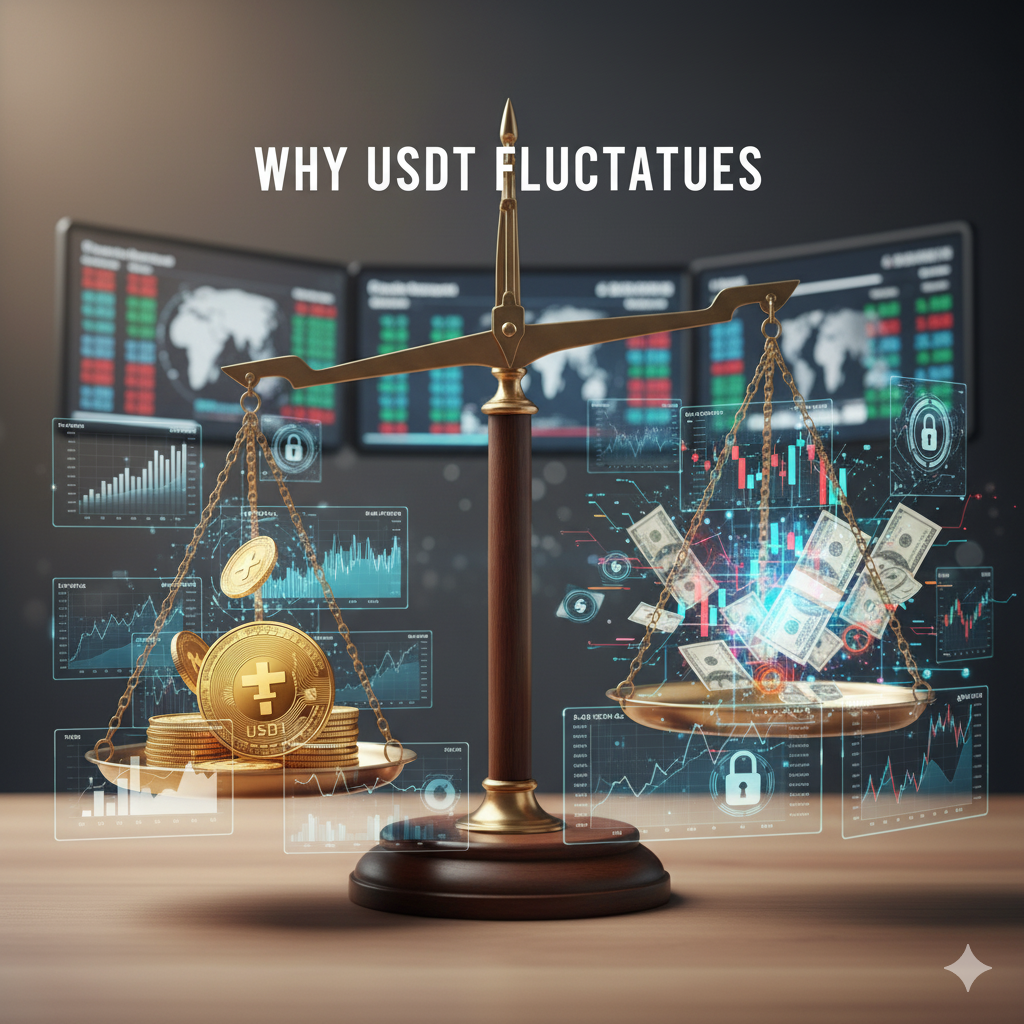
You rely on USDT because, theoretically, 1 USDT always equals $1 USD. This Trust in stability allows digital nomads in Canggu to manage their business payments, tourists in Kuta to budget their holiday, and investors in Seminyak to park their wealth.
But then, the unexpected happens. You check your wallet just before a planned USDT sell to IDR, and suddenly, the rate is $0.995 or, worse, $1.005. That small fluctuation—the de-pegging—can wipe out the profit margin on your entire transaction, especially when dealing with large volumes. This deviation shatters the myth of perfect stability and forces a crucial question: If USDT is pegged to the dollar, why does USDT fluctuate, and what does that risk mean for your financial security in Bali?
The Technical and Psychological Fault Lines
The fluctuation of Tether (USDT) is a complex interplay of the issuer’s transparency, the underlying reserve assets, and rapid market sentiment driven by FUD (Fear, Uncertainty, and Doubt). Understanding these factors is the mark of a true crypto Expert.
A. The Reserve Controversy: The Foundation of Trustworthiness
- The Problem: USDT is a fiat-backed stablecoin. Its stability rests on the Trust that Tether, the issuing company, holds $1 USD (or highly liquid assets equivalent to $1 USD) for every 1 USDT issued. However, Tether has faced decades of scrutiny regarding the composition and full transparency of these reserves.
- The Fluctuation Cause: Concerns are often raised that a significant portion of the reserves are held in commercial paper, corporate debt, or other assets that are less liquid than physical cash. If a sudden “bank run” were to happen (mass users attempting to sell their USDT back to the issuer for USD), Tether’s ability to redeem every coin instantly could be impaired.
- The Impact in Bali: News of reserve audits or regulatory actions (often magnified on social media) instantly triggers panic selling, pushing the USDT price below $1 (a de-peg). This immediate loss of value impacts any transaction you attempt to make, whether you’re trying to buy goods in Legian or pay for accommodation in Sanur.
B. Market Mechanics: Supply, Demand, and Arbitrage
- Temporary De-Pegging: Even without major news, micro-fluctuations occur because of simple market forces.
- Price < $1 (Discount): If a significant number of people rush to sell USDT for Bitcoin or fiat simultaneously (often during a crypto market crash—a flight to perceived quality), the supply temporarily overwhelms demand on trade platforms. This pushes the price down to $0.995.
- Price > $1 (Premium): When the broader crypto market is crashing, many investors rush to buy USDT, seeing it as a safe haven. High demand can briefly push the price up to $1.005.
- The Arbitrage Effect: Expert traders, who are typically high-frequency algorithms operating near Bali Airport’s main fiber connection points, immediately jump in to “arbitrage” the difference, pushing the price back toward $1. They buy the cheap USDT and sell the expensive USDT, profiting from the slight fluctuation. However, their speed is often faster than a regular user’s, meaning you are left holding the stablecoin while it is temporarily undervalued.
C. Geographic and Liquidity Gaps
- Local Market Reality: The price of USDT in a liquid global market often differs slightly from the rate used by local OTC (Over-The-Counter) providers in areas like Kuta or Canggu.
- The Authority of Liquidity: If a local provider offers a rate slightly above the global peg, it indicates a high, localized demand for USDT because they need it for international payments. Conversely, a lower rate means they are liquidating excess supply. This local market dynamic means the fluctuation you experience is not just global but amplified by your specific location in Bali.
The core lesson is this: USDT fluctuates because its $1 peg is a psychological and financial commitment, not a technical guarantee. Vigilance and reliance on a highly trusted, stable counterparty are essential when dealing with it in a foreign market like Bali.
Stability Guaranteed—Your Fixed Rate Anchor in Bali
The key to financial security in Bali is removing the uncertainty caused by USDT’s inherent fluctuations and the risks associated with reserve concerns and market sentiment. You need a guaranteed USD-to-IDR rate that honors your Trust in the stablecoin’s value, regardless of a temporary de-peg.
Our service provides that stable anchor, backed by high liquidity and a reputation for Expert financial integrity.
- Fixed Rate Assurance: We offer a locked-in, USD-pegged IDR rate at the moment you confirm your transaction, insulating you from the micro-fluctuations and fear-driven drops that might occur while you are attempting to sell your USDT.
- Expert Risk Management: We absorb the short-term de-pegging risk (fluctuations between $0.99 and $1.01) on our end. This is our promise of Authority—we handle the market noise so you receive the full IDR value for your USDT sell to fund your life in Seminyak, Legian, or Sanur.
- Verified Security and Speed: Our process is simple, secure, and fast, utilizing the efficient TRC-20 network to ensure that the moment the transaction leaves your wallet, your IDR is ready for immediate transfer or cash pickup in any major Bali location, from Bali Airport to Canggu.
Stop gambling on the stability of your USDT. Choose a trusted partner that guarantees your funds are honored at the true USD equivalent, providing the financial confidence you need to operate anywhere in Bali.
For a fixed-rate, secure, and expert service to sell your USDT for Indonesian Rupiah, eliminating the risk of sudden price fluctuations, contact our verified service immediately: +6285167055236
Would you like a brief analysis on how the US Federal Reserve’s interest rate decisions can indirectly impact the stability of USDT?